

Selling a business does not necessarily mean every responsibility ends on completion day.
Depending on the sale documents and the arrangements agreed with the buyer, a seller may still have handover tasks, contractual commitments, employee matters, adjustments or other practical steps to complete after the transaction settles.
The key is to work from the documents you actually signed rather than assuming that responsibility automatically passes to the buyer at completion.
This guide explains some of the post-sale obligations a business seller may need to consider and how to organise the remaining tasks after completion.
Key Takeaways
- A seller’s responsibilities can continue after completion where the sale documents require further action.
- Start with the signed contract, schedules, variations and any transition or side agreements.
- Post-sale matters may include handover assistance, records, warranties, adjustments, employee matters and confidentiality.
- Keep a written list of outstanding actions, deadlines and dependencies.
- Employee entitlements can be treated differently depending on whether there is a transfer of business and the circumstances of the transaction.
- Legal advice can clarify contractual obligations, while accounting and tax matters should be addressed with the appropriate adviser.
Table of Contents
- What Can Remain After Completion?
- Which Sale Documents Define Your Ongoing Responsibilities?
- Post-Sale Checklist for Business Sellers
- Handover and Transition Assistance
- Employees After a Business Sale
- Warranties, Adjustments and Other Continuing Obligations
- Tax and Accounting Follow-Up
- When Legal Advice May Help
- Frequently Asked Questions
Post-Sale Obligations for a Business Seller: What Can Remain After Completion?
Completion is an important milestone, but it may not be the end of the seller’s involvement.
Depending on the transaction, post-sale obligations may include:
- providing agreed handover assistance;
- training the buyer or its staff;
- introducing customers, suppliers or other contacts;
- providing business records or system access;
- complying with confidentiality obligations;
- dealing with post-completion adjustments;
- responding to matters covered by warranties;
- completing employee-related obligations;
- addressing outstanding lease or licence matters; and
- completing tax, accounting or administrative steps.
Not every business sale includes each of these obligations. The starting point should always be the documents governing your particular transaction.
What Does Completion Mean?
Completion generally refers to the point at which the agreed steps required to complete the transaction take place.
Depending on the deal, this may involve payment of the purchase price, transfer of assets or shares, release of security interests, delivery of documents and other agreed completion steps.
However, some obligations can continue after completion if the contract or related documents say so.
Asset Sale or Share Sale?
The structure of the transaction can also affect what remains after completion.
In an asset sale, the buyer generally acquires specified assets of the business. In a share sale, the buyer acquires shares in the company that operates the business.
Those structures can produce different legal, employment, tax and commercial consequences, so the sale structure should be considered together with the contract and the wider transaction documents.
You can learn more about Rise Legal’s business sale and purchase services.
Which Sale Documents Define Your Ongoing Responsibilities?
Start with the executed sale contract, but do not stop there.
Other relevant documents may include:
- schedules to the contract;
- variations;
- disclosure documents;
- transition or handover agreements;
- consultancy or assistance arrangements;
- restraint provisions;
- lease assignment documents;
- licences;
- completion statements;
- adjustment statements; and
- correspondence recording agreed changes.
Read the documents together rather than relying only on a clause heading.
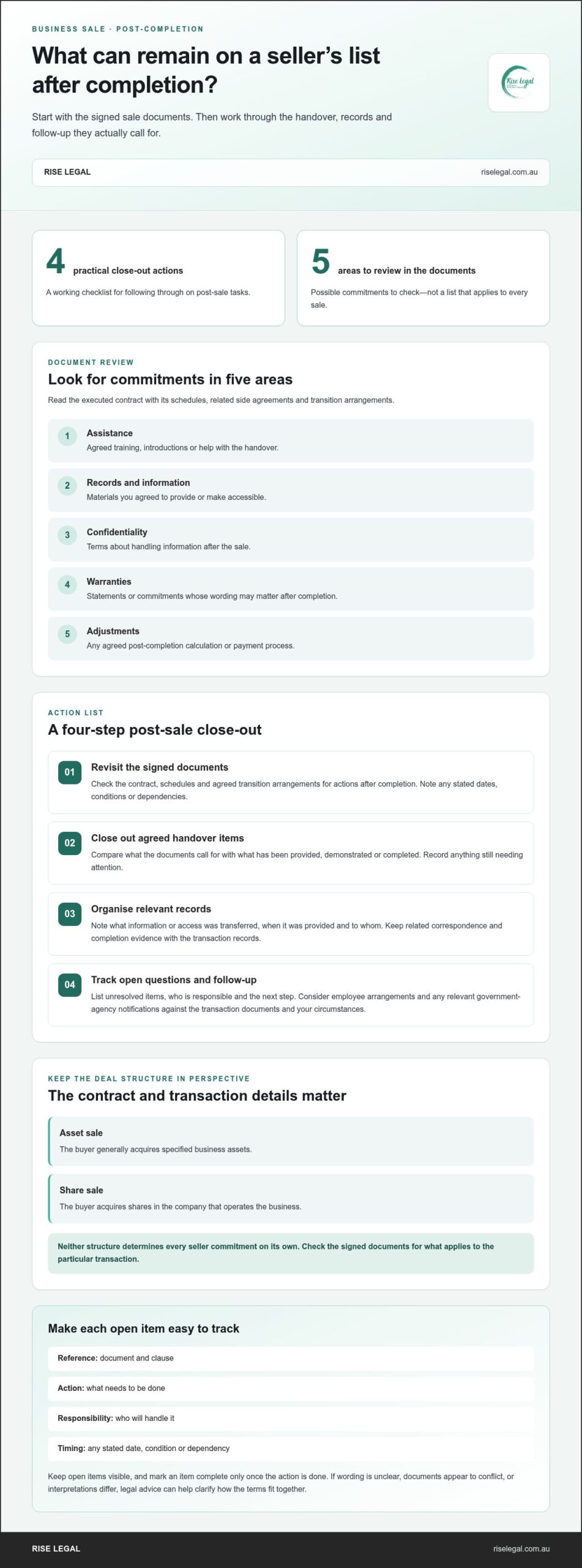
Common Areas to Check
- Handover and assistance: Any agreed training, introductions or transition support.
- Records and information: Documents, data, system access or other materials you agreed to provide.
- Confidentiality: Restrictions on how information may be used after the sale.
- Warranties: Statements or contractual promises that may continue to have relevance after completion.
- Adjustments: Calculations or payments that are finalised after completion.
- Restraints: Any post-sale restrictions relating to competition, customers or staff.
Turn the Contract Into an Action List
For each outstanding obligation, record:
- the relevant document;
- the clause or section;
- the action required;
- who is responsible;
- the due date;
- anything the action depends on; and
- whether the task has been completed.
Build the checklist from the actual signed documents rather than assumptions about what usually happens after a business sale.
A Practical Post-Sale Checklist for Business Sellers
1. Revisit the Signed Documents
Review the sale contract, schedules and related agreements for anything that must happen after completion.
Record all relevant dates, conditions and dependencies.
2. Complete the Agreed Handover
Check that the information, access, introductions, training and other assistance promised under the transaction documents have actually been provided.
Do not assume that a handover obligation is finished simply because completion has occurred.
3. Keep Evidence of What Was Provided
Keep appropriate records showing:
- what was provided;
- when it was provided;
- who received it; and
- any acknowledgement or correspondence confirming completion.
4. Track Outstanding Matters
Maintain a list of unresolved items, who is responsible and what needs to happen next.
If an obligation depends on something the buyer must first provide, record that dependency.
5. Review Employee Matters
Check how the sale affects employees and which responsibilities sit with the seller and buyer.
6. Check Warranties and Adjustments
Identify any provisions that continue after completion and any calculations or payments that still need to be finalised.
7. Complete Administrative and Professional Follow-Up
Consider whether government notifications, registrations, tax matters or accounting tasks remain outstanding.
Handover and Transition Assistance
Many business sale contracts include some form of handover or transition period.
This may involve:
- introducing customers;
- introducing suppliers;
- training the buyer;
- explaining operating procedures;
- providing passwords or system access;
- transferring records;
- assisting with licences or accounts; or
- remaining available for a specified period.
The scope and duration of the assistance should be determined from the contract or other agreed arrangements.
A buyer asking for additional help does not necessarily mean the seller is contractually required to provide it.
Employees After a Business Sale
Employee matters require particular attention because the position can depend on the transaction structure and whether there is a transfer of business under the Fair Work Act.
Where there is a transfer of business, a new employer generally has to recognise an employee’s prior service when calculating certain entitlements, including personal and carer’s leave, parental leave and eligibility to request flexible working arrangements.
However, different rules can apply to other entitlements such as:
- annual leave;
- redundancy;
- long service leave;
- notice of termination; and
- unfair dismissal service.
For example, in some circumstances a new employer that is not an associated entity can decide not to recognise prior service for annual leave. In that case, the old employer may be required to pay out accumulated annual leave.
The treatment of employees should therefore be checked carefully rather than relying on a general assumption that all entitlements automatically transfer to the buyer.
The Fair Work Ombudsman provides detailed information about employee entitlements when a business changes owners.
Warranties, Adjustments and Other Continuing Obligations
Warranties
A sale contract may contain warranties given by the seller about the business, assets, accounts, contracts, liabilities or other matters.
The fact that completion has occurred does not necessarily mean those provisions are no longer relevant.
Check:
- which warranties were given;
- whether there are contractual time limits;
- how the buyer must make a claim;
- whether there are financial limits or exclusions; and
- which obligations continue after completion.
The effect of warranty provisions depends on the wording of the sale contract.
Post-Completion Adjustments
Some transactions include adjustments that are calculated or finalised after completion.
Depending on the agreement, these might relate to matters such as:
- stock;
- employee entitlements;
- rent;
- prepaid expenses;
- customer deposits;
- working capital; or
- other agreed amounts.
Check the method, timing and evidence required under the contract rather than assuming the adjustment process is automatic.
Tax and Accounting Follow-Up
A business sale can also create tax and accounting obligations after completion.
Depending on the transaction, matters may include:
- capital gains tax;
- GST;
- BAS reporting;
- final accounts;
- payroll matters;
- asset accounting;
- employee entitlements; and
- record keeping.
These matters should be discussed with your accountant or tax adviser.
Legal advice can help explain what the sale documents require, but tax and accounting treatment should be confirmed with an appropriately qualified adviser.
When Legal Advice May Help After a Business Sale
Legal advice may be useful where:
- a post-completion obligation is unclear;
- the buyer and seller interpret a clause differently;
- different transaction documents appear inconsistent;
- the buyer requests assistance that may go beyond the agreed handover;
- a warranty issue is raised;
- an adjustment is disputed or unclear;
- a restraint or confidentiality provision needs to be understood; or
- you are unsure whether a contractual obligation has been completed.
Rise Legal assists Australian business owners with business sale and purchase matters.
We can review transaction documents and provide advice about the contractual obligations they contain.
Rise Legal provides fixed-fee proposals for defined legal work, so the scope and professional fee are agreed before work begins.
Close Out the Sale Methodically
A completed sale does not necessarily mean every loose end has disappeared.
The simplest approach is to work methodically through the signed documents, identify each remaining obligation and record when it has been completed.
Keep contractual tasks separate from tax, accounting and administrative matters so each issue can be directed to the appropriate adviser.
If you are unsure what a post-completion provision requires, contact Rise Legal about your business sale documents.
Frequently Asked Questions
Do Business Sellers Have Obligations After Completion?
They can.
The seller may have obligations that continue after completion depending on the sale contract and related transaction documents.
These may include handover assistance, confidentiality, warranties, adjustments or other agreed matters.
How Long Can a Seller Remain Responsible After Selling a Business?
There is no single timeframe that applies to every business sale.
Different obligations may have different time limits, conditions or expiry dates under the sale documents.
Check the wording of the relevant provision rather than assuming all obligations finish at the same time.
Does a Seller Have to Help the Buyer After Completion?
Only where the transaction documents or another agreed arrangement require the seller to provide assistance, or where the parties subsequently agree to further help.
The contract may define the type of assistance, the period for which it must be provided and any limits on the seller’s involvement.
What Happens to Employees When a Business Is Sold?
The position depends on the circumstances and whether there is a transfer of business.
Some employee service and entitlements must generally be recognised by the new employer, while different rules can apply to annual leave, redundancy, long service leave and other matters.
Employee arrangements should be considered carefully as part of the transaction.
Can a Buyer Make a Warranty Claim After Completion?
Potentially.
The answer depends on the warranties in the sale contract, any contractual limits or notice requirements and the circumstances giving rise to the claim.
Who Deals With Tax After a Business Sale?
Tax and accounting consequences should be discussed with an accountant or tax adviser.
A lawyer can advise on the contractual terms of the sale, but tax treatment may depend on matters outside the legal scope of the transaction documents.

Article by
Helen Kay, Principal Lawyer, Rise Legal
Helen Kay is the Managing Director and Principal Lawyer at Rise Legal, an Australian commercial and business law firm advising business owners, franchisors and franchisees across Australia. Helen practises in commercial law, franchising, business contracts, business sales and purchases, trademarks and related business law matters.
Disclaimer
This article provides general information only and does not constitute legal advice. It does not take into account your specific circumstances. Laws and regulatory requirements may change, so you should obtain legal advice relevant to your situation before acting on the information contained in this article. Liability limited by a scheme approved under professional standards legislation.