

Registering a Trademark in Australia: 6 Things to Consider Before You Apply
If you are thinking about registering a trademark in Australia, the application itself may look straightforward. The more important decisions often happen before anything is filed.
Who should own the trademark? What exactly should be protected? Does the proposed registration reflect where the business is heading? Are there earlier trademarks that could cause problems?
Getting those decisions wrong can result in gaps in protection, additional applications or unnecessary cost.
This article explains six issues Australian businesses should consider before applying for trademark protection, without attempting to replace advice specific to your business or proposed brand.
Key Takeaways
- A registered business name does not give you the same rights as a registered trademark.
- The correct owner should be considered before the application is filed.
- The goods and services covered by the application affect the scope of protection.
- Earlier similar trademarks may affect registration.
- Your future business plans can matter when deciding what protection is appropriate.
- Some filing mistakes can be difficult or costly to correct later.
1. Who Should Own the Trademark?
Trademark ownership should not be treated as an administrative detail.
The appropriate owner may be an individual, company, trustee or another legal entity, depending on how the business and its intellectual property are structured.
Problems can arise where the trademark is registered in one person’s name while another entity actually operates the business, develops the brand or licences it to others.
This can become particularly important when:
- a business is sold;
- new shareholders or investors come in;
- a brand is licensed;
- a franchise network is established; or
- intellectual property is moved between entities.
It is generally easier to consider ownership properly before filing than to deal with unintended consequences later.
2. What Exactly Are You Protecting?
Many businesses use several elements as part of their brand, such as a business name, logo, product name, slogan or other distinctive feature.
Those elements are not necessarily protected in the same way.
A business therefore needs to consider which part of the brand has the greatest commercial value and what it actually wants its trademark protection to cover.
For some businesses, the name itself is the main asset. For others, a logo or separate product brand may also be important.
The right approach depends on how the brand is used and how customers identify it.
3. Which Goods and Services Matter?
A registered trademark does not automatically provide exclusive rights across every type of product or service.
The registration relates to the goods and services covered by the application.
This makes the scope of the application an important commercial decision.
An application that is too narrow may fail to cover an important part of the business. An application prepared without regard to future plans may also need to be revisited as the business expands.
IP Australia warns that classes need to be considered carefully before filing. Standard applications generally cannot simply be expanded later to include missed classes, and a further application may be required.
This is one reason businesses should think beyond what they sell today and consider realistic future use of the brand.
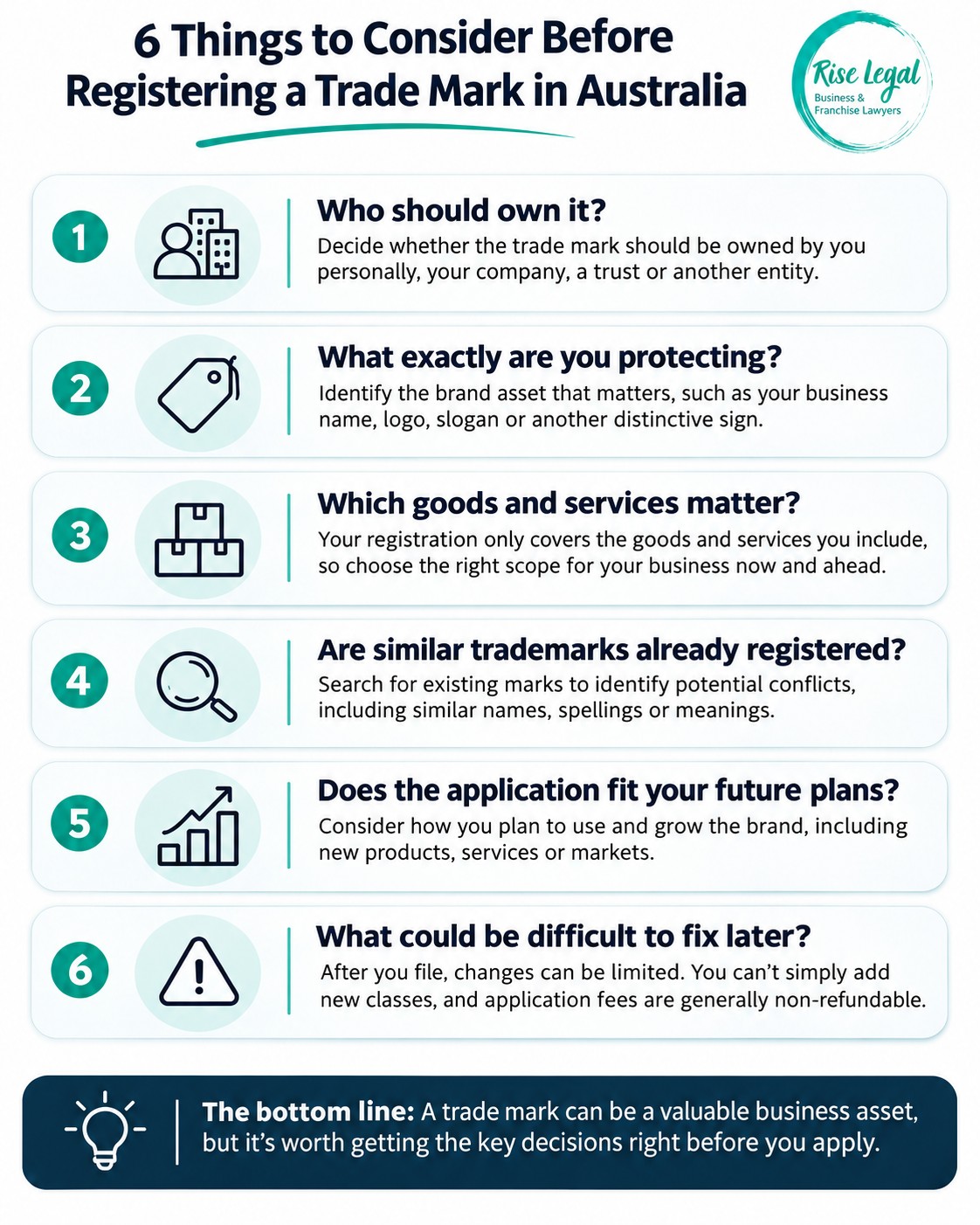
4. Could Earlier Trademarks Create a Problem?
The availability of a business name through ASIC does not mean the name is necessarily available for trademark registration.
Trademark rights and business name registrations are different.
An earlier trademark may affect an application even if the names are not identical.
For an important brand, it is worth assessing existing trademark rights before investing heavily in websites, signage, packaging, marketing or a launch.
This is particularly relevant where another business already uses a similar brand in a related area.
5. Does the Application Fit Your Future Plans?
A trademark can remain registered for many years, so it makes sense to consider where the business may be heading rather than looking only at its current activities.
For example, a business may later:
- launch additional products;
- provide new services;
- license its brand;
- expand interstate or nationally;
- develop a franchise model; or
- create separate brands for different parts of the business.
Your trademark strategy should reflect realistic commercial plans rather than being treated as a one-off filing exercise.
6. What Could Be Difficult to Fix Later?
One of the main reasons to consider the application carefully before filing is that some mistakes cannot simply be corrected afterwards.
IP Australia advises that standard applications can generally only be amended in limited ways. Significant changes may require a new application and further fees.
Application fees are also generally non-refundable because the fee pays for examination of the application rather than guaranteeing registration.
That means filing quickly without considering ownership, scope or earlier rights can result in avoidable cost.
Business Name Registration Is Not Trademark Protection
This distinction causes a lot of confusion.
Registering a business name with ASIC allows a business to operate under that name. It does not itself give the business exclusive intellectual property rights in the name.
The same applies to registering a company name or purchasing a domain name.
A business can therefore hold a registered business name and still encounter trademark issues with another party.
For businesses investing heavily in a brand, trademark protection should be considered separately from their ASIC registrations and domain names.
Why Trademark Applications Can Become More Complicated Than Expected
Some applications proceed without major difficulty. Others encounter issues that were not obvious when the business first chose the brand.
Potential concerns can include:
- similar earlier trademarks;
- descriptive or commonly used wording;
- questions about ownership;
- the scope of goods or services;
- the particular version of the brand being protected; or
- objections raised during examination.
The existence of an issue does not automatically mean a trademark cannot be registered. It does mean the circumstances should be considered before deciding how to proceed.
What Happens If IP Australia Raises Concerns?
IP Australia examines trademark applications and may issue an examination report if it identifies an issue.
The appropriate response depends on the reason for the objection and the circumstances surrounding the proposed trademark.
For some businesses, this is the point at which an apparently simple application becomes significantly more involved.
Getting advice before filing may reduce the risk of encountering avoidable problems later, although no adviser can guarantee that an application will be accepted or unopposed.
Can Someone Oppose a Trademark?
Acceptance by IP Australia is not necessarily the final step.
Australian trademark law provides an opposition process that may allow another party to challenge registration where relevant grounds exist.
This is another reason to consider existing rights and potential conflicts before committing significant resources to a new brand.
How Long Does an Australian Trademark Last?
An Australian trademark registration lasts for 10 years from its filing date and can be renewed for further 10-year periods.
There is no limit to the number of renewals.
IP Australia allows renewal during the 12 months before expiry. If the renewal date is missed, there is generally a six-month grace period, with additional fees applying.
Should You Review Existing Trademarks as Your Business Changes?
Yes.
A trademark portfolio that suited a business five years ago may not reflect what the business does today.
Changes in products, services, branding, ownership or expansion plans can create gaps between the registered protection and the way the brand is actually used.
Periodic review can help identify those gaps before they become commercially significant.
When Is Professional Trademark Advice Worth Considering?
Professional advice may be particularly useful where:
- the brand is commercially important;
- you intend to invest significantly in marketing or expansion;
- similar trademarks already exist;
- there is uncertainty about who should own the trademark;
- the business operates across several products or services;
- the trademark will be licensed or franchised;
- you have received an examination report; or
- you want to understand the likely scope of protection before filing.
For an important business asset, the objective should not simply be to submit an application. It should be to obtain protection that properly reflects the brand and how the business intends to use it.
Trademark Lawyers Australia
Rise Legal assists Australian businesses with trademark applications and intellectual property matters.
We can help you consider the proposed trademark, ownership, scope of protection and potential issues before managing the application process with IP Australia.
Our trademark services are offered on a fixed-fee basis, with the scope and professional fee agreed upfront.
If your brand matters to your business and you want to get the application right from the outset, contact Rise Legal to discuss your trademark.
Frequently Asked Questions
Does a registered business name protect my brand?
No. Registering a business name through ASIC does not itself give you exclusive trademark rights in that name.
How long does a registered trademark last in Australia?
An Australian trademark registration lasts for 10 years from its filing date and can be renewed for further 10-year periods.
Can I change a trademark application after filing?
Some amendments may be possible, but IP Australia limits the changes that can be made to a standard application. Significant changes may require a further application and additional fees.
Are trademark application fees refundable if the application is unsuccessful?
Generally no. IP Australia explains that application fees pay for examination of the application and do not guarantee registration.
Can an existing trademark affect my application even if the names are not identical?
Potentially. Earlier trademarks do not necessarily need to be identical to create an issue. The circumstances, including the marks and the relevant goods or services, need to be considered.
Should my trademark be owned personally or by my company?
There is no single answer. The appropriate owner depends on your business and intellectual property structure, which is why ownership should be considered before filing.

Article by Helen Kay, Principal Lawyer, Rise Legal
Helen Kay is the Managing Director and Principal Lawyer at Rise Legal, an Australian commercial and business law firm advising business owners, franchisors and franchisees across Australia. Helen practises in commercial law, franchising, business contracts, business sales and purchases, trademarks and related business law matters.
Disclaimer
This article provides general information only and does not constitute legal advice. It does not take into account your specific circumstances. Laws and regulatory requirements may change, so you should obtain legal advice relevant to your situation before acting on the information contained in this article. Liability limited by a scheme approved under professional standards legislation.