

Warranties and Indemnities in Business Sales
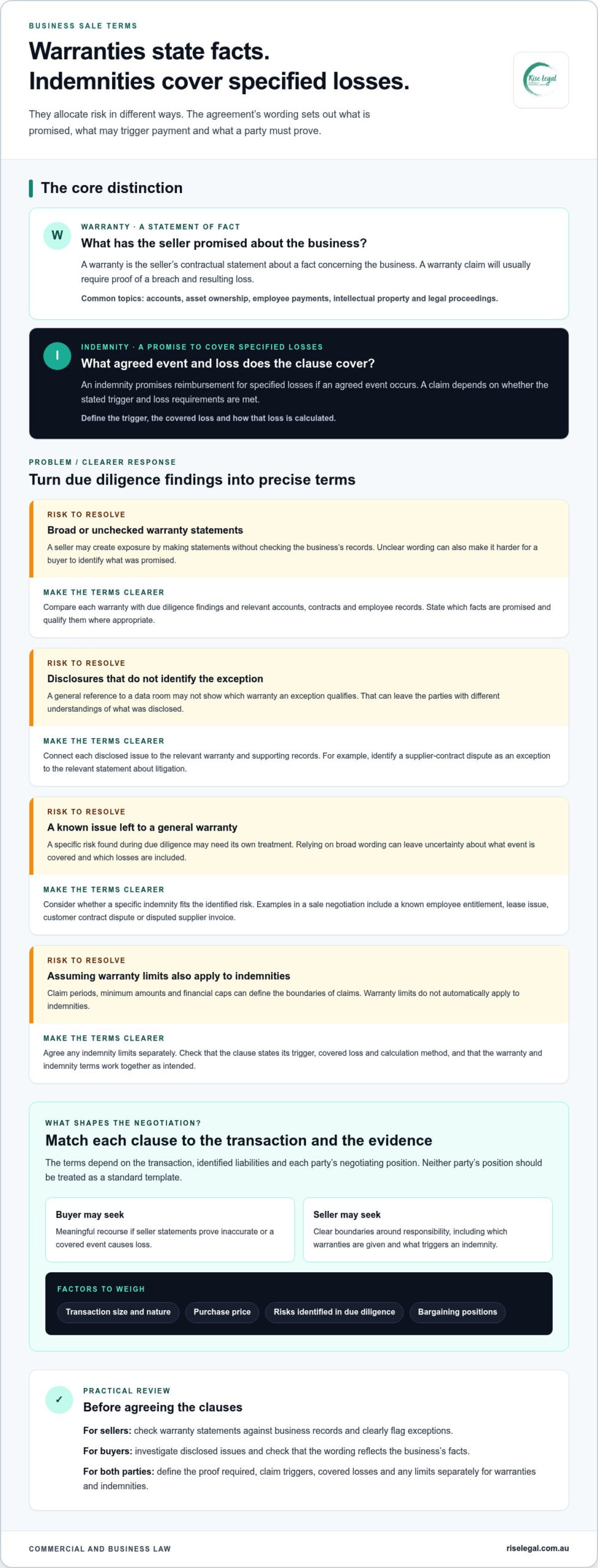
A warranty is a seller’s contractual statement about a fact concerning a business. An indemnity is a promise to cover specified losses if an agreed event occurs.
In a business sale, these clauses can play an important role in deciding who carries particular risks after completion. Warranties usually provide broader contractual assurances about the business, while indemnities are commonly used to deal with specific risks identified during negotiations or due diligence.
The wording of the sale agreement matters. It determines what has been promised, when a claim may arise, what the buyer must establish and what limits apply.
This guide explains how warranties and indemnities in business sales operate, how disclosure can affect them and why caps, thresholds, notice requirements and claim deadlines need careful attention.
Key Takeaways
- Warranties are contractual statements about the business, while indemnities usually respond to specified risks or losses.
- Sellers should review warranty statements against their records and clearly disclose relevant exceptions.
- Buyers should not treat warranties as a replacement for proper due diligence.
- Limits applying to warranty claims may not automatically apply to indemnities.
- Contractual notice and claim deadlines should be tracked separately from applicable statutory limitation periods.
- The precise wording of the sale agreement determines the scope of each party’s rights and obligations.
What Are Warranties in a Business Sale?
A warranty is a contractual statement made by one party, commonly the seller, about a particular fact or circumstance concerning the business being sold.
Typical warranties may deal with matters such as:
- ownership of business assets;
- financial accounts and records;
- customer and supplier contracts;
- employee entitlements;
- intellectual property;
- legal proceedings or claims;
- tax matters; and
- compliance with applicable laws.
The warranties relevant to a transaction depend on the type of business, the sale structure and the risks identified during the transaction.
Warranty wording and qualifications
The wording of a warranty determines what the seller is actually promising.
For sellers, broad statements that are not properly checked or qualified can create unnecessary exposure. For buyers, vague or heavily qualified warranties may provide less protection than expected.
Each warranty should therefore be considered against the information uncovered during due diligence and the records of the business.
For example, a warranty stating that the business owns all intellectual property used in its operations should be checked against trade mark registrations, licence arrangements, contractor agreements and other relevant records.
Disclosure letters and exceptions
A seller may disclose particular matters as exceptions to warranties.
For example, if a supplier has threatened legal action, the seller might disclose that matter as an exception to a warranty stating that there are no material disputes affecting the business.
Clear disclosure allows the parties to identify known risks before completion rather than dealing with them later as an unexpected issue.
The level of detail matters. Simply referring generally to documents in a data room may not always make it clear which warranty a particular issue is intended to qualify.
Sellers should compare proposed warranties with their accounts, contracts, employment records and other business documents. Buyers should review the disclosed exceptions and consider how they affect the transaction.
This can be particularly important in a share sale, where the buyer acquires the company together with its existing history, contractual obligations, assets and liabilities.
What Is an Indemnity in a Business Sale?
An indemnity is a contractual promise requiring one party to cover specified losses if an agreed event occurs.
Rather than providing a broad statement about the business, an indemnity is often used to deal with a particular identified exposure.
For example, if due diligence identifies an unpaid employee entitlement, the parties might negotiate a specific indemnity dealing with that liability instead of relying only on a general warranty.
The indemnity should clearly identify:
- the event that triggers the obligation;
- the losses or liabilities covered;
- how the amount is calculated;
- any exclusions;
- applicable caps or thresholds;
- notice requirements; and
- how third-party claims are handled.
Specific drafting makes it easier for both parties to understand the risk being allocated.
Warranties vs Indemnities: What Is the Difference?
The practical difference usually lies in what must be established when something goes wrong.
A warranty claim generally concerns a contractual statement that turns out to be inaccurate. The buyer will ordinarily need to establish the relevant breach and show that loss resulted from it.
An indemnity operates according to its particular wording. If the agreed trigger occurs and the claimed loss falls within the clause, the indemnity may provide a contractual right to payment without requiring the buyer to establish a separate breach of warranty.
That does not mean an indemnity automatically provides unlimited recovery. The agreement may contain exclusions, caps, notice requirements or other conditions affecting the claim.
A practical example
Assume a business sale agreement contains a warranty stating that there are no material disputes with suppliers.
If a dispute already existed and had not been disclosed, the buyer may later allege that the warranty was inaccurate and seek to establish the loss caused by the breach.
Alternatively, if the parties already know about the supplier dispute before completion, they may negotiate a specific indemnity dealing with losses arising from that particular matter.
The warranty provides a broader contractual assurance. The indemnity deals with a defined risk the parties already know about.
Negotiating Warranties and Indemnities
Buyers and sellers approach these clauses from different commercial positions.
A buyer generally wants meaningful recourse if important information about the business proves inaccurate or an identified liability arises after completion.
A seller generally wants its responsibilities clearly defined and appropriately limited.
There is no single standard set of warranties or indemnities suitable for every business sale.
The transaction size, purchase price, business operations, due diligence findings, sale structure and bargaining positions of the parties can all affect the final terms.
For example, due diligence might identify concerns involving:
- a commercial lease;
- unpaid employee entitlements;
- a customer or supplier dispute;
- tax liabilities;
- ownership of intellectual property;
- a key contract;
- regulatory compliance; or
- an outstanding claim.
The agreement can then address the identified concern directly rather than relying on broad wording that leaves the allocation of risk uncertain.
Limits on Warranty and Indemnity Claims
Business sale agreements commonly contain provisions limiting certain claims.
These may include:
- a financial cap on liability;
- a minimum value before an individual claim may be made;
- a basket requiring several qualifying claims to reach an agreed total;
- time limits for notifying claims;
- deadlines for starting proceedings;
- requirements concerning the content of a claim notice; and
- exclusions for matters already disclosed to the buyer.
It is important not to assume that limitations applying to warranties automatically apply to indemnities.
If the parties intend a cap, threshold or claim period to apply to an indemnity, the agreement should make that clear.
If you are reviewing sale terms, our business contract advice can help you understand how these provisions fit together.
Disclosure and Due Diligence
Warranties do not replace due diligence.
A buyer should investigate the business, review relevant records and consider the information supplied by the seller before entering into the transaction.
At the same time, a seller should not treat due diligence as a substitute for accurate disclosure.
A seller should carefully review the warranties proposed in the sale agreement and identify any statements that require qualification or disclosure.
Clear disclosure can also affect commercial negotiations. If the buyer knows about a liability before completion, the parties can consider that issue when negotiating the price, the sale terms or a specific indemnity.
Claim Notices and Contractual Deadlines
A business sale agreement may specify when and how a buyer must notify the seller of a claim.
A notice provision may require the buyer to:
- identify the alleged breach or relevant indemnity;
- describe the circumstances giving rise to the claim;
- provide an estimate of the claimed loss;
- include supporting information; and
- deliver the notice using a specified method.
Some agreements also require proceedings to be started within a particular period after notice is given.
Giving notice does not necessarily preserve a claim indefinitely if the agreement contains a separate deadline for commencing proceedings.
Buyers and sellers should therefore keep clear records of contractual notice periods and any proceedings deadlines.
Statutory Limitation Periods
Contractual claim periods need to be considered separately from statutory limitation periods.
Limitation legislation differs between Australian states and territories. Depending on the jurisdiction and the type of claim, a limitation period may apply from the date the relevant cause of action accrues.
For example, Queensland legislation generally provides a six-year limitation period for an action founded on simple contract.
The Australian Consumer Law also contains separate statutory time limits. Section 236 provides that an action for damages arising from conduct contravening relevant provisions of Chapters 2 or 3 may generally be commenced within six years after the relevant cause of action accrued.
A contractual warranty claim period and a statutory cause of action are not necessarily the same thing. Different claims may involve different legal requirements, accrual dates and limitation periods.
That is why it is important to identify the legal basis of a potential claim and review both the agreement and the applicable legislation rather than relying on a single deadline.
De Minimis Thresholds and Claim Baskets
Some business sale agreements exclude very small claims by using a de minimis threshold.
They may also include a basket requiring qualifying claims to reach a specified combined value before the buyer can recover.
The drafting should make clear:
- the minimum value of an individual qualifying claim;
- which claims count towards the basket;
- the value the basket must reach; and
- whether the buyer can recover the entire amount once the threshold is reached or only the amount above it.
These provisions can materially affect whether a claim is commercially worthwhile.
Warranty and Indemnity Insurance
Warranty and indemnity insurance may be available for some transactions.
It can provide cover for certain losses arising from breaches of warranties or other insured matters, subject to the particular policy terms.
Availability and cover depend on the transaction, due diligence undertaken, identified risks, policy exclusions, limits and notice requirements.
Insurance does not replace careful due diligence or appropriate drafting of the sale agreement.
Buying or Selling a Business?
Rise Legal assists business owners with the legal aspects of business sales and purchases.
This can include reviewing or preparing sale documents, advising on warranties and indemnities, due diligence issues, negotiations, lease matters and other contractual arrangements forming part of the transaction.
Where a transaction involves a franchise, the sale may also need to be considered alongside the relevant franchise documents and regulatory requirements.
We also advise on related business contracts, Terms & Conditions and trade mark and intellectual property matters where relevant to the transaction.
Before You Sign
Before signing a business sale agreement, consider whether its warranties and indemnities reflect the deal you believe you are making.
Review the assumptions that matter to the transaction, the information disclosed by the seller and the way the agreement allocates known and unknown risks.
The wording of warranties and indemnities can affect what happens if information later proves inaccurate or a particular liability emerges.
If you are preparing, buying or selling a business, contact Rise Legal to discuss the transaction before you commit.
Frequently Asked Questions
What is an indemnity?
An indemnity is a contractual promise to cover specified losses if an agreed event occurs. The scope of the obligation depends on the wording of the clause, including the trigger, losses covered, exclusions, limits and claim requirements.
Can an indemnity create uncapped liability?
Potentially. If an indemnity is not subject to an applicable financial cap or other contractual limitation, the potential exposure may be significantly broader than the parties expect. The agreement should be checked to determine which limitations apply to warranties, indemnities or both.
What is the purpose of a warranty in a business sale?
Warranties provide contractual assurances about matters relevant to the buyer’s decision to acquire the business. They may also help focus due diligence by identifying matters that should be checked before completion.
What should be considered before giving an indemnity?
The parties should identify the event triggering the indemnity, the losses covered, how the amount will be calculated, applicable exclusions or caps, notice requirements and the process for managing third-party claims.
What warranties are commonly included in an Australian business sale agreement?
Common subjects include ownership of business assets, financial accounts, employee obligations, contracts, intellectual property, litigation, tax matters and legal compliance. The appropriate warranties depend on the particular business and transaction.

Article by Helen Kay, Principal Lawyer, Rise Legal
Helen Kay is the Managing Director and Principal Lawyer at Rise Legal, an Australian commercial and business law firm advising business owners, franchisors and franchisees across Australia. Helen practises in commercial law, franchising, business contracts, business sales and purchases, trade marks and related business law matters.
Disclaimer
This article provides general information only and does not constitute legal advice. It does not take into account your specific circumstances. Laws and regulatory requirements may change, so you should obtain legal advice relevant to your situation before acting on the information contained in this article. Liability limited by a scheme approved under professional standards legislation.