

Shareholders Agreement Australia: What Should It Cover?
A shareholders agreement in Australia can help business owners document how they will make decisions, fund the company, distribute profits, transfer shares and deal with disagreements or exits.
A company constitution and the Corporations Act also regulate how a company operates, but they do not necessarily record the specific commercial arrangements the shareholders have agreed between themselves.
For companies with two or more owners, a well-drafted shareholders agreement can provide a clearer framework for managing the business relationship before disagreements arise.
Key Takeaways
- A shareholders agreement and company constitution serve different purposes and should work together.
- The agreement can document decision-making, funding commitments, information rights, dividends and share transfers.
- Deadlock provisions can provide a process where shareholders cannot agree on an important decision.
- Transfer provisions can address pre-emptive rights, tag-along rights, drag-along rights and shareholder exits.
- Funding provisions should explain what happens if the company needs additional capital and a shareholder cannot or does not want to contribute.
- The agreement should reflect the company’s actual ownership, management structure and commercial arrangements rather than relying on a generic template.
What Is a Shareholders Agreement?
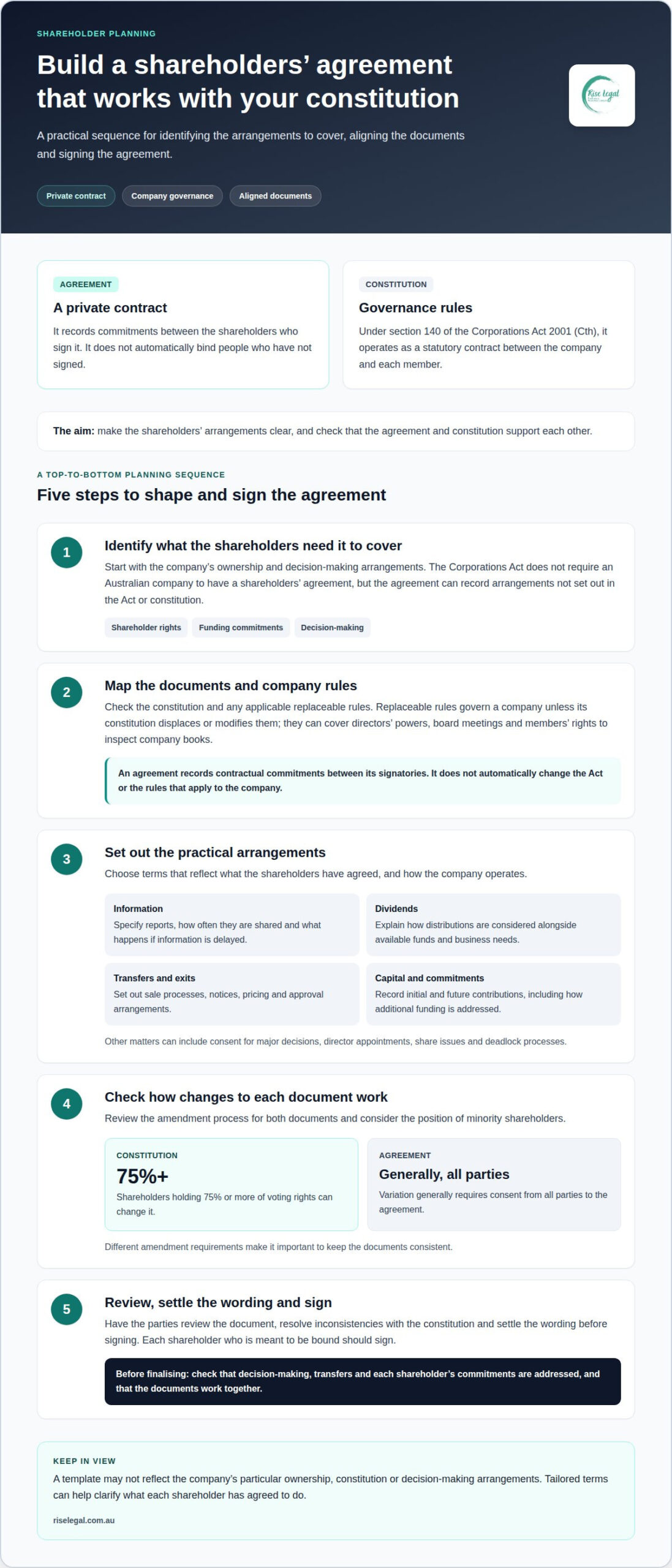
A shareholders agreement is a private contract between the parties who sign it.
It commonly records how shareholders intend to manage their relationship with each other and may address matters such as:
- ownership and voting rights;
- board appointments;
- important business decisions;
- shareholder funding;
- dividend expectations;
- access to information;
- the issue of new shares;
- share transfers;
- deadlocks;
- shareholder exits; and
- what happens if a shareholder dies, becomes incapacitated or wants to leave.
The Corporations Act does not generally require a company to have a shareholders agreement. However, relying only on the Corporations Act and constitution may leave important commercial arrangements between the owners undocumented.
Shareholders Agreement vs Company Constitution
A shareholders agreement and company constitution are different documents.
Under section 140 of the Corporations Act 2001 (Cth), a company’s constitution and applicable replaceable rules operate as a statutory contract between:
- the company and each member;
- the company and each director and company secretary; and
- each member and the other members.
A shareholders agreement is instead a contractual arrangement between the parties who enter into it.
This distinction matters because a shareholders agreement does not automatically change the Corporations Act or constitution, and a person who has not agreed to be bound by the shareholders agreement will not generally become a party simply because they own shares.
Why Should the Constitution and Shareholders Agreement Be Reviewed Together?
The two documents can deal with overlapping issues such as director appointments, voting, share transfers and decision-making.
If their terms do not align, uncertainty can arise about what the company is authorised to do and what the shareholders have contractually agreed between themselves.
For example, shareholders might agree that certain significant decisions require a particular level of shareholder approval. The constitution should be reviewed to check that its governance provisions support the intended arrangement.
A company constitution can generally be adopted, amended or repealed by special resolution. A special resolution ordinarily requires at least 75% of the votes cast by members entitled to vote on the resolution.
Changing a shareholders agreement will instead depend on the amendment provisions contained in that agreement.
What Are Replaceable Rules?
The Corporations Act contains a set of company governance rules known as replaceable rules.
Depending on the company, these rules can apply instead of, or alongside, provisions in a company constitution.
They deal with matters including:
- directors’ powers;
- appointment and removal of directors;
- directors’ meetings;
- shareholder meetings;
- share issues;
- share transfers;
- inspection of company books; and
- dividends.
Replaceable rules do not apply in exactly the same way to every company, so the company’s particular governance arrangements should be checked.
Decision-Making and Reserved Matters
One of the most useful functions of a shareholders agreement is to identify which decisions can be made in the ordinary course of business and which require additional shareholder approval.
These significant decisions are often referred to as reserved matters.
Depending on the company, reserved matters might include:
- taking on substantial new debt;
- issuing additional shares;
- changing the nature of the business;
- buying or selling a major asset;
- entering into a significant contract;
- appointing or removing key executives;
- changing the company’s business plan;
- making a major acquisition;
- selling the business; or
- making another material financial commitment.
The agreement can specify the level of approval required for different decisions.
This can be particularly important for minority shareholders who may want certain significant decisions to require more than a simple majority.
Board Appointments
A shareholders agreement can also address who has the right to nominate directors to the board.
For example, a shareholder holding a particular percentage of shares might have an agreed right to nominate one director while they continue to maintain that level of ownership.
The constitution should be reviewed alongside these provisions so that the agreed appointment process is consistent with the company’s governance rules.
A director nominated by a shareholder still owes their directors’ duties to the company. They do not simply act as the representative of the shareholder who nominated them.
Shareholder Information Rights
Shareholders do not manage the company’s day-to-day operations merely because they hold shares.
A shareholders agreement can, however, establish practical information and reporting rights.
These might include access to:
- management accounts;
- annual budgets;
- financial statements;
- cash-flow forecasts;
- board reports; and
- other agreed business information.
The agreement can also state how frequently particular reports must be provided and to whom.
This can be particularly valuable where some shareholders work in the business while others are primarily investors.
Dividends
Shareholders may have different expectations about how profits will be used.
One shareholder may prefer profits to be distributed while another may want funds retained to finance growth.
A shareholders agreement can establish a framework or policy for considering dividends, but it cannot override the legal requirements applying to dividend payments.
Under section 254T of the Corporations Act, a company must not pay a dividend unless:
- its assets exceed its liabilities immediately before the dividend is declared and the excess is sufficient for the payment;
- the payment is fair and reasonable to the company’s shareholders as a whole; and
- the payment does not materially prejudice the company’s ability to pay its creditors.
The company’s constitution and applicable replaceable rules should also be considered.
Shareholder Contributions and Future Funding
Businesses often require additional funding after the initial investment.
A shareholders agreement can explain what happens when the company needs further capital.
It may address:
- whether shareholders are required to provide further funding;
- whether contributions are optional;
- how funding requirements are approved;
- whether funding is provided as equity or a shareholder loan;
- what happens if one shareholder contributes and another does not;
- whether additional shares may be issued; and
- how any resulting dilution is handled.
These questions are worth agreeing on while relations between shareholders are good rather than waiting until the company urgently needs funds.
Shareholder Loans
Money provided by a shareholder to the company should be distinguished from money contributed in return for shares.
If funds are provided as a loan, the parties should consider documenting matters such as:
- the amount advanced;
- interest, if any;
- repayment terms;
- security;
- priority relative to other debts; and
- what happens to the loan if the shareholder exits.
Tax advice may also be required.
For example, Division 7A can have tax consequences where a private company provides certain loans, payments or benefits to shareholders or their associates.
Issuing New Shares and Dilution
An issue of new shares can change the ownership percentages of existing shareholders.
For example, if one shareholder takes up additional shares and another does not, the second shareholder’s percentage ownership may decrease.
A shareholders agreement can establish how future share issues are approved and may provide existing shareholders with pre-emptive opportunities to participate in a new issue.
The company’s constitution and applicable Corporations Act provisions should also be considered when shares are issued.
Share Transfers
Most shareholders agreements contain rules governing when and how shares can be transferred.
Without an agreed process, the remaining shareholders could find themselves in business with a new shareholder they did not select.
Transfer provisions may include:
Pre-emptive or First-Offer Rights
Existing shareholders may be given the opportunity to purchase shares before they are offered to an external buyer.
The agreement should explain the process, timing and method for establishing the sale price.
Tag-Along Rights
Tag-along provisions can protect minority shareholders when a majority shareholder proposes to sell their shares.
They can allow eligible minority shareholders to participate in the sale on the terms specified in the agreement.
Drag-Along Rights
Drag-along provisions can allow shareholders meeting an agreed threshold to require remaining shareholders to participate in a qualifying sale.
These provisions can help facilitate a whole-company sale where a buyer is unwilling to acquire anything less than all shares.
The trigger, threshold and sale conditions should be drafted carefully.
What Is a Shareholder Deadlock?
A deadlock occurs when the required approval for an important decision cannot be obtained.
This is particularly common in companies owned equally by two shareholders because neither has sufficient control to resolve a disagreement alone.
A deadlock can prevent decisions about matters such as:
- budgets;
- business strategy;
- borrowing;
- major expenditure;
- hiring;
- expansion; or
- the sale of the business.
Deadlock Resolution
A shareholders agreement can establish a process for dealing with deadlocks.
The appropriate mechanism depends on the company and the relationship between its owners.
Common steps may include:
- formal notice of the deadlock;
- a meeting between the shareholders;
- good-faith negotiations;
- mediation;
- referral of a particular technical issue to an independent expert; and
- an agreed shareholder exit mechanism if the deadlock cannot be resolved.
The agreement can also explain what happens to ordinary business operations while the deadlock process is underway.
Deadlock Exit Mechanisms
If discussions and mediation cannot resolve a fundamental disagreement, an agreement may provide a mechanism for one or more shareholders to exit.
The clause should address matters such as:
- what triggers the exit process;
- how notice is given;
- how shares are valued;
- who can buy the shares;
- payment arrangements; and
- what happens if no shareholder can or wants to purchase them.
A deadlock clause that creates an exit right but provides no workable valuation or sale process may simply create another disagreement.
What Happens if a Shareholder Wants to Leave?
A shareholders agreement can establish an agreed process for voluntary and involuntary exits.
Events that may be addressed include:
- a shareholder choosing to sell;
- retirement;
- death;
- permanent incapacity;
- bankruptcy;
- serious breach of the agreement;
- termination of employment where the shareholder also works in the business; and
- another agreed trigger event.
The agreement should explain what happens to the person’s shares and how the price will be determined.
How Are Shares Valued on Exit?
Valuation provisions can become extremely important when a shareholder leaves.
The agreement may use:
- an agreed valuation methodology;
- an independent valuer;
- a formula;
- market value; or
- another agreed approach.
The appropriate method depends on the company and circumstances.
It is also worth addressing who appoints the valuer, who pays the valuation costs and how disagreements about the process are resolved.
Majority and Minority Shareholders
Share ownership gives different shareholders different levels of voting power, but the relationship cannot always be understood simply by looking at percentages.
The company’s constitution, share classes, applicable replaceable rules and shareholders agreement may all affect decision-making.
A shareholders agreement can provide minority shareholders with agreed protections around matters such as:
- reserved decisions;
- new share issues;
- access to information;
- changes to the business;
- related-party transactions;
- major borrowing;
- tag-along rights; and
- sale of the company.
Shareholders Own Shares, Not Company Assets
A company has a separate legal existence from its shareholders.
Shareholders own shares in the company. They do not personally own the company’s bank account, equipment, intellectual property or other business assets.
This distinction becomes particularly important when shareholders disagree, contribute property to the business or consider selling their interest.
If a shareholder personally owns an asset that the business uses, that ownership and any licence or transfer arrangement should be documented separately.
Shareholders Agreement and Business Sales
Share transfer provisions become particularly important if one or more owners later want to sell.
The agreement may determine:
- who must be offered shares first;
- how the price is established;
- when an outside buyer can be approached;
- whether minority shareholders can participate in a sale;
- whether remaining shareholders can be required to sell; and
- what approvals are needed.
A sale of shares is also legally different from a sale of the company’s underlying business assets.
If a proposed transaction develops, our business sales and purchases lawyers can assist with the transaction alongside the company’s existing shareholder arrangements.
Do You Need a Shareholders Agreement?
Australian companies are not generally required to have a shareholders agreement.
However, businesses with multiple owners may benefit from documenting how those owners intend to deal with matters that are not adequately addressed by the constitution or replaceable rules.
This can be particularly useful where:
- there are two equal shareholders;
- some shareholders work in the business and others do not;
- shareholders have contributed different amounts;
- future funding is likely;
- minority shareholders require agreed protections;
- different shareholders have board nomination rights; or
- the owners want a clear process for future exits.
Can You Use a Shareholders Agreement Template?
A template can identify common topics, but it may not reflect the company’s actual ownership, constitution or commercial arrangements.
For example, a generic agreement may use voting thresholds that do not work with the company’s shareholding, contain an unsuitable deadlock process or conflict with the constitution.
Before relying on a template, consider:
- the company’s share structure;
- each shareholder’s voting rights;
- board composition;
- funding arrangements;
- the constitution;
- applicable replaceable rules;
- expected shareholder roles; and
- how shareholders want to deal with future exits.
When Should You Review a Shareholders Agreement?
A shareholders agreement should continue to reflect how the company is actually owned and operated.
Reviewing it may be appropriate when:
- a new shareholder joins;
- an existing shareholder leaves;
- new shares are issued;
- responsibilities between owners change;
- the company raises significant new funding;
- the business expands materially;
- the constitution changes; or
- the shareholders begin considering a sale.
Shareholders Agreement Lawyers Australia
Rise Legal assists Australian business owners with shareholders agreements, ownership arrangements and related commercial contracts.
We can help prepare or review a shareholders agreement and consider how it interacts with your company’s constitution, share structure and intended decision-making arrangements.
For defined legal work, Rise Legal offers fixed-fee proposals and upfront pricing so you know the scope and professional fee before work begins.
Contact Rise Legal if you would like to discuss a shareholders agreement for your business.
Frequently Asked Questions
Is a shareholders agreement legally required in Australia?
No. Australian companies are not generally required by the Corporations Act to have a shareholders agreement. However, one can document arrangements between shareholders that may not otherwise appear in the company’s constitution or the replaceable rules.
What is the difference between a constitution and a shareholders agreement?
A constitution governs the company’s internal management and has statutory contractual effect under the Corporations Act. A shareholders agreement is a separate contractual arrangement between the parties who enter into it. The documents should be reviewed together so their provisions are consistent.
Can a shareholders agreement protect a minority shareholder?
It can provide agreed protections such as approval rights for reserved matters, information rights, pre-emptive rights and tag-along provisions. The appropriate protections depend on the company’s ownership and commercial arrangements.
What happens if two 50/50 shareholders disagree?
A shareholders agreement can include a deadlock procedure involving negotiation, mediation and, where necessary, an agreed exit mechanism. Without an effective process, an unresolved disagreement may prevent important company decisions from being made.
Can shareholders be required to contribute more money?
That depends on the company’s arrangements and the terms shareholders have agreed. A shareholders agreement can specify if and when further contributions may be required and what happens if a shareholder does not participate.
What are tag-along and drag-along rights?
Tag-along rights can allow eligible minority shareholders to participate when a controlling shareholder sells. Drag-along rights can allow shareholders meeting an agreed threshold to require other shareholders to participate in a qualifying sale, subject to the terms of the agreement.

Article by Helen Kay, Principal Lawyer, Rise Legal
Helen Kay is the Managing Director and Principal Lawyer at Rise Legal, an Australian commercial and business law firm advising business owners, franchisors and franchisees across Australia. Helen practises in commercial law, franchising, business contracts, business sales and purchases, trademarks and related business law matters.
Disclaimer
This article provides general information only and does not constitute legal advice. It does not take into account your specific circumstances. Laws and regulatory requirements may change, so you should obtain legal advice relevant to your situation before acting on the information contained in this article. Liability limited by a scheme approved under professional standards legislation.