

A franchise renewal can look straightforward until the new documents arrive and the terms are different from the agreement you have been operating under.
Fees may change. Territory rights may be different. New operating requirements, refurbishment obligations or updated supplier arrangements may be introduced. Your lease may also need to line up with the proposed new franchise term.
Before agreeing to a renewal, take the time to understand what your current Franchise Agreement says, what the franchisor is proposing and which issues matter most to your business.
These franchise renewal negotiation tips explain what Australian franchisees should review, how to prepare practical negotiation requests and when legal advice may be useful before signing.
Key Takeaways
- Start with the renewal clause in your existing Franchise Agreement and record all relevant notice dates and conditions.
- Do not assume the new agreement will contain the same terms as your current agreement.
- Compare fees, territory, operating requirements, refurbishment obligations, supplier arrangements and any linked lease.
- Prioritise your negotiation points and explain the commercial reason behind each request.
- Check that any agreed changes appear correctly in the final written documents before signing.
- The Franchising Code contains important end-of-term and renewal provisions that should be considered alongside your agreement.
Table of Contents
- Start With Your Franchise Agreement
- Check the Renewal and End-of-Term Notice Requirements
- Which Renewal Terms Should You Review?
- Franchising Code Considerations
- How to Negotiate Franchise Renewal Terms
- When Legal Advice May Help
- Frequently Asked Questions
Franchise Renewal Negotiation Tips: Start With Your Agreement
Your first step should be to read the renewal or extension provisions in your existing Franchise Agreement.
Check:
- whether you have an option to renew or extend;
- when notice must be given;
- how notice must be given;
- which conditions must be satisfied;
- whether outstanding breaches must be remedied;
- whether refurbishment or capital expenditure is required;
- whether a renewal fee applies;
- whether you must enter into the franchisor’s then-current Franchise Agreement; and
- whether any lease or licence arrangements must also be renewed.
Record the relevant dates rather than relying on memory. Missing a contractual notice period can affect your renewal rights.
Gather the Relevant Documents
Before renewal discussions begin, bring together:
- your current Franchise Agreement;
- any variations or amendments;
- renewal or end-of-term notices;
- the current Disclosure Document;
- any proposed new Franchise Agreement;
- lease or licence documents;
- correspondence about renewal; and
- any information about proposed refurbishment or capital expenditure.
A franchise agreement review can help you understand the legal effect of proposed renewal terms before you respond.
Set Your Negotiation Priorities
Not every issue needs to be treated as equally important.
A practical approach is to divide your concerns into:
- essential issues: matters that materially affect whether you are prepared or able to continue;
- preferred changes: terms you would like improved but could potentially work around; and
- fallback positions: alternatives that may still produce a workable outcome.
Connect each request to a particular clause or commercial issue. If a proposed refurbishment programme creates a significant cost or would interrupt trading, for example, explain the impact and identify the change you would like considered.
Check the Renewal and End-of-Term Notice Requirements
The Franchising Code contains specific end-of-term notification requirements.
For most franchise agreements other than new vehicle dealership agreements, a franchisor must notify the franchisee in writing whether it intends to:
- extend the existing agreement;
- enter into a new Franchise Agreement with the franchisee; or
- do neither.
Where the franchise term is six months or longer, that notice generally needs to be given at least six months before the end of the term. For terms of less than six months, the period is generally at least one month.
If the franchisor intends to extend the agreement, the notice must also include information about the franchisee’s ability to request a Disclosure Document, subject to the Code requirements.
These statutory notice requirements operate alongside the renewal provisions in your own Franchise Agreement, so both should be checked.
Which Franchise Renewal Terms Should You Review and Negotiate?
Do not assume the new agreement will simply continue your existing terms.
Compare the proposed documents against the current agreement and identify every material change.
| Area to Review | Questions to Consider | Possible Discussion Point |
|---|---|---|
| Term and renewal | How long is the proposed term and are future renewal rights different? | Clarify the new term and any renewal conditions. |
| Fees and charges | Have royalties, marketing contributions, technology fees or other charges changed? | Ask for clarity around amounts, calculation methods and timing. |
| Territory | Have territorial rights, exclusivity or online sales provisions changed? | Clarify boundaries and rights affecting your operating area. |
| Operating requirements | Are there new staffing, supplier, technology or operational requirements? | Understand the cost and practical effect before accepting them. |
| Refurbishment | Are upgrades, works or new equipment required? | Ask for the scope, timing and expected requirements to be documented. |
| Supply arrangements | Have approved supplier requirements or purchasing obligations changed? | Clarify the commercial effect of the proposed arrangements. |
| Personal guarantees | Are existing or new guarantors required? | Understand the extent of personal obligations. |
| Lease | Does the lease term align with the proposed franchise term? | Consider how the two arrangements work together. |
| Restraints | Have restraint provisions changed? | Review the wording and the circumstances in which it may apply. |
Check the Franchising Code in Context
Australian franchising is regulated by the mandatory Competition and Consumer (Industry Codes—Franchising) Regulations 2024.
As at October 2026, the current version is Compilation No. 1, effective from 21 October 2025.
The Franchising Code regulates a range of matters relevant to franchise renewals and end-of-term arrangements, including disclosure, good faith, capital expenditure, end-of-term notices and certain restraint provisions.
Renewal Is Not Automatically Guaranteed
A franchisee is not automatically entitled to another franchise term simply because the existing agreement is approaching expiry.
The position depends on the Franchise Agreement, including any renewal or extension option, the conditions attached to that option and the applicable Franchising Code requirements.
Restraints After a Franchise Is Not Renewed
The Franchising Code also contains specific provisions dealing with restraint of trade clauses where a Franchise Agreement is not renewed or extended.
Those provisions apply only where particular statutory conditions are satisfied, including matters relating to the franchisee’s request for renewal, compliance with renewal conditions, serious breaches and intellectual property or confidentiality obligations.
A restraint clause should therefore be reviewed in the context of the agreement, renewal correspondence and the Franchising Code rather than assuming that the wording of the clause alone determines the position.
How to Negotiate Franchise Renewal Terms Constructively
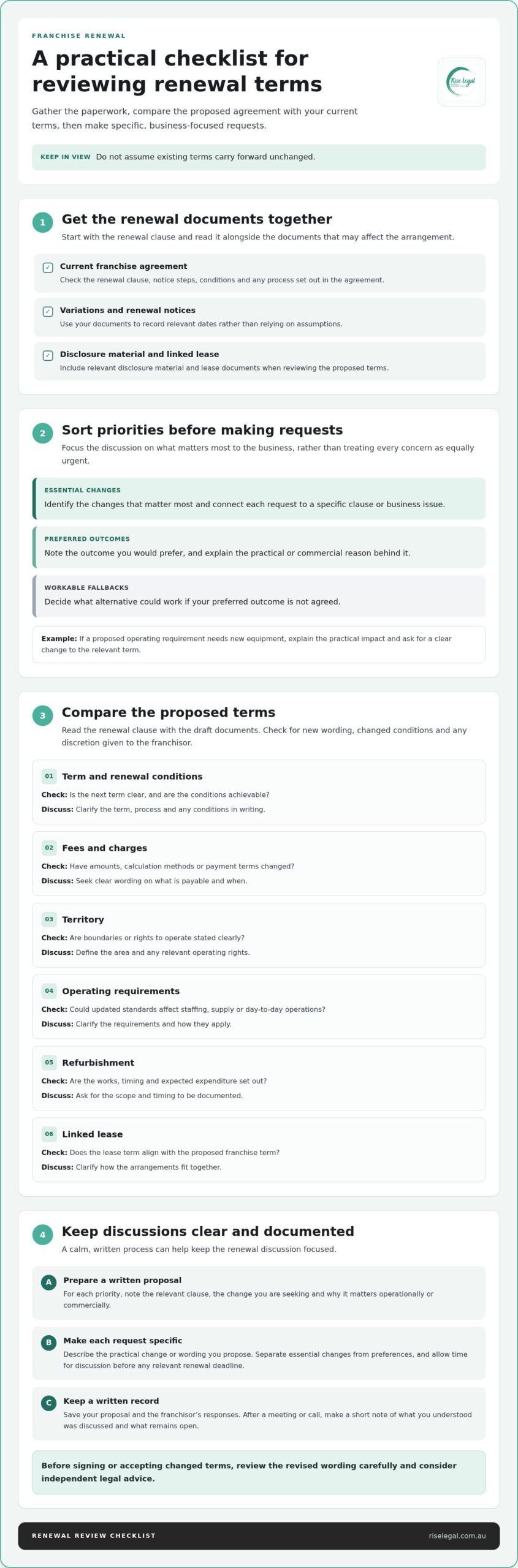
Once you understand the documents and have identified your priorities, turn each issue into a specific request.
1. Prepare Your Requests in Writing
For each negotiation point, note:
- the relevant clause;
- the change you are requesting;
- why the issue matters to the business; and
- any alternative position that may be workable.
Keep the explanation practical and specific.
For example, if a proposed refurbishment programme would interrupt trading for several weeks, explain the timing issue and propose an alternative rather than simply objecting to refurbishment altogether.
2. Prioritise Your Requests
Start with the matters that have the greatest commercial impact.
This makes it easier for the franchisor to understand which issues genuinely affect your decision about renewal and which points are preferences.
3. Keep a Written Record
Keep copies of:
- your written proposals;
- the franchisor’s responses;
- revised agreements;
- emails confirming discussions; and
- notes of unresolved issues.
After an important phone call or meeting, a short written summary can help confirm what was discussed and identify any points still outstanding.
4. Review Every Revised Draft
Do not assume that the latest draft contains only the changes that were discussed.
Compare each revised document with:
- your existing agreement;
- the previous renewal draft;
- your negotiation notes; and
- the changes you understood had been agreed.
Check that agreed amendments have been recorded accurately and whether any other provisions have changed.
5. Check the Final Documents Before Signing
A verbal agreement about a proposed change should not be treated as a substitute for reviewing the final written documents.
Before signing, make sure the Franchise Agreement and any related documents reflect the arrangement you understand you are accepting.
When Franchise Renewal Legal Advice May Help
Legal advice can be particularly useful where:
- the proposed agreement is substantially different from your current agreement;
- renewal conditions are unclear;
- fees or other financial obligations have changed;
- new refurbishment or capital expenditure requirements are proposed;
- territory rights have changed;
- the franchise term and lease term do not align;
- new personal guarantees are required;
- restraint provisions have changed; or
- you are unsure how the Franchising Code applies to the proposed renewal.
What a Franchise Agreement Review Can Cover
A franchise agreement review can help identify:
- the requirements of the renewal clause;
- material differences between the current and proposed agreement;
- new obligations;
- changes to fees or commercial rights;
- issues requiring clarification;
- relevant Franchising Code provisions; and
- questions you may wish to raise with the franchisor.
A legal review can explain the agreement and relevant legal issues, but it cannot guarantee that the franchisor will agree to proposed changes or that renewal will produce a particular commercial outcome.
Legal advice is also separate from accounting, tax and financial advice. For example, a lawyer can explain a fee obligation in the agreement, while assessing whether the business can afford that fee may require financial or accounting advice.
Rise Legal assists franchisees across Australia with franchise agreement reviews and franchising advice.
Before You Commit to a Franchise Renewal
A renewal deadline should not be treated as a reason to accept terms you have not properly considered.
Before signing:
- confirm the relevant renewal dates;
- compare the old and new agreements;
- review linked lease documents;
- identify any new costs or obligations;
- record unresolved negotiation points;
- check that agreed changes appear in the final documents; and
- seek advice where the legal effect of a provision is unclear.
If you would like help reviewing proposed renewal documents, contact Rise Legal about a fixed-fee franchise agreement review.
Frequently Asked Questions
Is a Franchisor Required to Renew a Franchise Agreement?
Not necessarily.
A franchisee is not automatically entitled to a further term. Renewal or extension rights depend on the Franchise Agreement, any applicable conditions and the current Franchising Code.
Can You Negotiate a Franchise Agreement Renewal in Australia?
Yes. A franchisee can propose changes to renewal terms.
The franchisor is not necessarily required to accept those changes, so negotiation should focus on specific provisions and the practical commercial reasons behind each request.
When Should I Start Preparing for Franchise Renewal?
Start early enough to identify the notice periods and conditions in your Franchise Agreement and to consider any proposed new documents before a decision is required.
The Franchising Code also contains end-of-term notification requirements, so the contractual and statutory timeframes should be considered together.
Can My Franchise Agreement Change When I Renew?
Potentially.
A renewal or new Franchise Agreement may contain terms that differ from your existing agreement, particularly where the franchisor requires franchisees to enter into its current form of agreement.
Compare the proposed agreement carefully rather than assuming the existing provisions will continue unchanged.
Can a Franchise Agreement Include a Restraint After Expiry?
A franchise agreement may contain a restraint clause, but the Franchising Code places restrictions on certain restraints where a franchise agreement is not renewed or extended and particular statutory conditions are satisfied.
The wording and circumstances should be considered before assuming that a restraint will or will not apply.
Should I Have a Franchise Renewal Agreement Reviewed?
A review may be useful where the proposed terms have changed, important obligations are unclear, significant expenditure is required or the new agreement contains provisions you do not fully understand.
Rise Legal provides fixed-fee franchise agreement reviews for Australian franchisees.

Article by
Helen Kay, Principal Lawyer, Rise Legal
Helen Kay is the Managing Director and Principal Lawyer at Rise Legal, an Australian commercial and business law firm advising business owners, franchisors and franchisees across Australia. Helen practises in commercial law, franchising, business contracts, business sales and purchases, trademarks and related business law matters.
Disclaimer
This article provides general information only and does not constitute legal advice. It does not take into account your specific circumstances. Laws and regulatory requirements may change, so you should obtain legal advice relevant to your situation before acting on the information contained in this article. Liability limited by a scheme approved under professional standards legislation.