

Buying a Franchise From an Existing Owner: What Should You Consider?
Buying a franchise from an existing owner can look simpler than starting a new franchise because the business is already operating.
But you are not simply buying an established business. You are also entering an ongoing legal relationship with the franchisor and becoming subject to the franchise agreement, the Franchising Code of Conduct and the operating system of the network.
The existing franchisee’s performance is therefore only one part of the picture.
Before committing to the purchase, it is important to understand how the transfer works, what rights you will actually receive, what obligations you will take on and what could affect your ability to operate or later sell the business.
Key Takeaways
- Buying an existing franchise usually requires the franchisor’s involvement and approval.
- The franchise agreement can affect your ability to operate, sell or exit the business.
- The performance of the current outlet should be considered separately from the strength of the franchise system.
- Existing contracts, leases, employees and liabilities can affect the transaction.
- Independent legal and financial advice can help identify issues before you become committed.
1. The Franchisor Still Matters
When buying an existing franchise, it is easy to focus mainly on the seller and the performance of the individual business.
However, the franchisor will remain a major part of the relationship after completion.
The franchisor may control or influence matters such as:
- branding;
- approved suppliers;
- operating systems;
- marketing;
- training;
- territory arrangements;
- business standards;
- future changes to the system; and
- your ability to sell the franchise later.
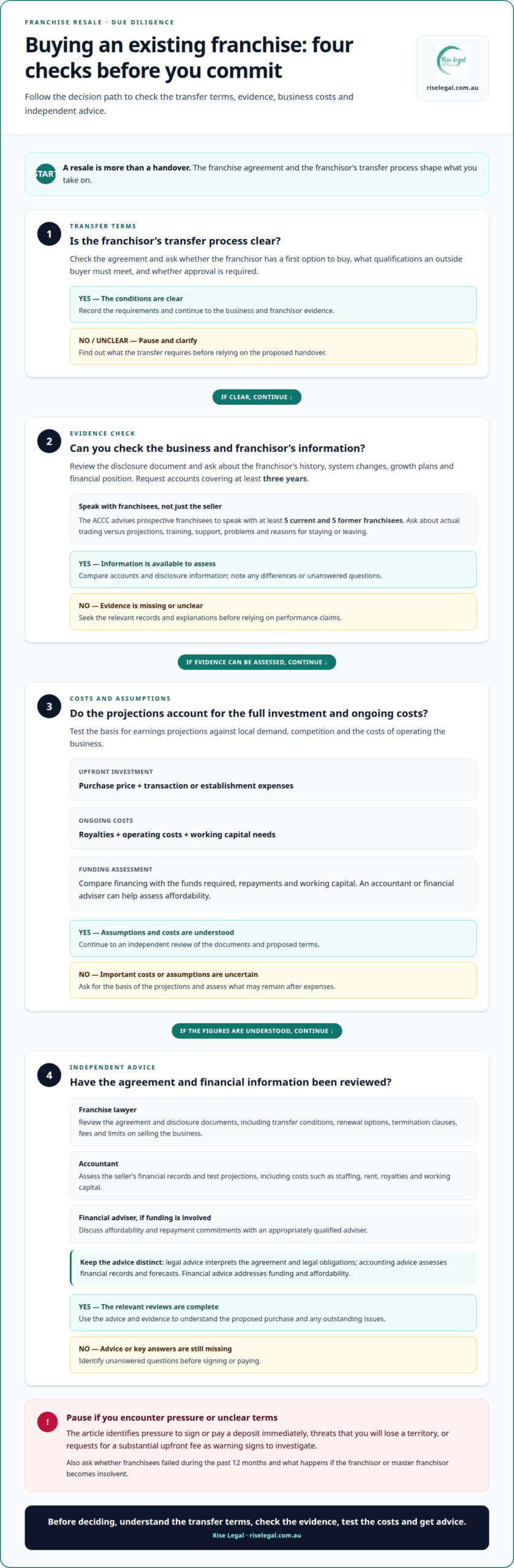
The ACCC recommends that prospective franchisees understand the franchise system, speak with current and former franchisees and obtain independent professional advice before committing.
The franchise opportunity should therefore be assessed as both a business purchase and a long-term contractual relationship.
2. The Transfer Is Not Simply Between Buyer and Seller
A resale usually involves more than an agreement between the existing franchisee and the buyer.
The franchisor will commonly have rights under the franchise agreement regarding the proposed transfer.
Those rights may include:
- approving the incoming franchisee;
- requiring the buyer to meet selection criteria;
- requiring training;
- requiring documents to be signed;
- requiring outstanding amounts to be addressed; or
- requiring other transfer conditions to be satisfied.
Under the current Franchising Code of Conduct, franchisors must not unreasonably withhold consent to a transfer.
However, the transfer process still needs to be understood before the buyer becomes committed to the transaction.
3. What Franchise Agreement Will You Be Entering?
A buyer should not assume that they will simply step into the seller’s existing arrangement on identical terms.
Depending on the transaction and franchise system, the buyer may enter into a new franchise agreement, take a transfer of an existing agreement or be required to satisfy other documentation requirements.
The legal structure of the transfer matters because it can affect:
- the remaining franchise term;
- renewal rights;
- fees;
- territory rights;
- restraints;
- future refurbishment obligations;
- termination rights;
- transfer rights; and
- other ongoing obligations.
These terms can materially affect the value of the business being purchased.
4. How Long Is Left on the Franchise Term?
The remaining term of the franchise agreement is an important commercial issue.
A business may appear profitable today, but the buyer also needs to consider how long they will have the right to operate under the franchise system.
There may not be an automatic right to renew or extend the agreement.
The value of an existing franchise can therefore be affected by:
- the remaining agreement term;
- renewal provisions;
- conditions applying to renewal;
- planned refurbishment requirements; and
- the franchisor’s future intentions for the network.
The ACCC specifically warns prospective franchisees to understand what happens when the franchise agreement ends.
5. Support and Training Should Be Considered Carefully
The level of support offered by the franchisor can affect how easily a new owner transitions into the business.
Support may include matters such as:
- initial training;
- operational assistance;
- marketing resources;
- technology;
- business systems; and
- ongoing franchise support.
The important point is not simply what the franchisor says it provides, but what is actually documented and how the support operates in practice.
This is one reason the ACCC recommends speaking with existing and former franchisees before investing.
6. The Seller’s Financial Results Are Only Part of the Picture
An existing franchise has the advantage of a trading history, but historical results do not guarantee future performance.
Financial performance can be influenced by many factors, including:
- location;
- rent;
- staffing;
- owner involvement;
- local competition;
- royalties and franchise fees;
- supplier costs;
- marketing contributions;
- working capital; and
- changes within the franchise system.
Financial information should therefore be independently assessed rather than relying solely on headline revenue or profit figures provided during the sale process.
Accounting and financial advice is separate from legal advice and should form part of the buyer’s overall assessment.
7. What Happens to the Lease?
If the franchised business operates from leased premises, the lease can be just as important as the franchise agreement.
The proposed transaction may involve:
- assignment of the existing lease;
- a new lease;
- landlord consent;
- additional security or guarantees;
- refurbishment obligations; or
- changes to rental terms.
The lease term should also be considered alongside the franchise term.
A mismatch between the two can create commercial problems later.
8. What Happens to Employees?
Buying an existing franchise may also involve taking over an operating workforce.
Depending on how the transaction is structured, employee arrangements can involve questions about:
- offers of employment;
- accrued entitlements;
- service recognition;
- applicable awards or enterprise agreements; and
- transfer-of-business rules under the Fair Work Act.
The treatment of employees should be addressed as part of the transaction rather than left until completion.
9. What Liabilities Are You Actually Taking On?
The buyer should understand exactly what is included in the business purchase and what remains with the seller.
Potential issues may include:
- customer liabilities;
- supplier obligations;
- employee entitlements;
- equipment finance;
- lease obligations;
- gift vouchers or customer credits;
- outstanding complaints; and
- other business commitments.
The sale agreement should clearly allocate responsibility between the buyer and seller.
10. Could the Franchisor Change the System Later?
Buying an existing franchise does not mean the business will remain unchanged for the duration of the agreement.
Franchise systems can evolve.
Depending on the agreement and applicable law, changes may affect:
- operating procedures;
- technology;
- branding;
- approved products;
- suppliers;
- marketing;
- fit-out requirements; and
- other aspects of the business.
A prospective buyer should understand how much flexibility the franchisor has to change the system and what those changes could mean commercially.
11. How Easy Will It Be to Sell the Franchise Later?
Your eventual exit should be considered before you buy.
The franchise agreement may impose conditions on a future sale, including franchisor approval of the incoming buyer.
The current Franchising Code contains rules governing transfers and provides that a franchisor must not unreasonably withhold consent.
However, the practical ability to sell can still be affected by factors such as:
- the remaining franchise term;
- buyer selection requirements;
- transfer fees;
- lease arrangements;
- refurbishment requirements;
- the performance of the business; and
- the reputation and strength of the franchise system.
The ACCC also points out that the value of a franchise can decline as the remaining term of the agreement becomes shorter.
12. What Happens If the Relationship Ends?
Franchise agreements contain provisions dealing with expiry and termination.
Those provisions can affect what happens to:
- the business name and branding;
- signage;
- websites and social media;
- confidential information;
- stock and equipment;
- customer information;
- outstanding fees; and
- post-franchise restrictions.
The legal and commercial consequences of the agreement ending should be understood before the buyer commits to the purchase.
Buying an Existing Franchise Is Still a Franchise Purchase
An established outlet may feel less risky than starting a new franchise from scratch because there is already a trading history, staff, customers and operating infrastructure.
But the buyer is still becoming part of a franchise network and taking on the legal obligations that come with that relationship.
The existing owner cannot determine all of those obligations.
The franchise agreement, disclosure material, lease, business sale agreement and Franchising Code can all affect the transaction.
Why Independent Advice Matters
The ACCC recommends prospective franchisees obtain independent legal, accounting and business advice before buying a franchise.
Each adviser has a different role.
A franchise lawyer can help you understand the legal documents and obligations.
An accountant can assess the financial position and trading information.
A business or financial adviser may assist with broader commercial and funding questions.
Those reviews are particularly important where you are committing significant capital to an existing franchise and relying on the business to provide an ongoing income.
Franchise Lawyers for Buyers
Rise Legal assists franchise buyers across Australia with franchise agreement reviews and franchise purchase advice.
We can advise on the legal documents involved in buying an existing franchise, including the franchise agreement, disclosure material, transfer requirements and related commercial agreements.
Our franchise services are provided on a fixed-fee basis, with the scope and professional fee agreed upfront.
If you are considering buying an existing franchise, contact Rise Legal before committing to the purchase.
Frequently Asked Questions
Can you buy a franchise from an existing franchisee?
Yes. Existing franchised businesses can be sold, subject to the franchise agreement, the Franchising Code and the franchisor’s transfer requirements.
Does the franchisor have to approve the buyer?
The franchise agreement will usually contain a transfer process and buyer requirements. Under the Franchising Code, a franchisor must not unreasonably withhold consent to a transfer.
Should I rely on the seller’s financial figures?
No financial information should be accepted without appropriate independent assessment. Historical performance can be useful, but it does not guarantee future profitability.
Do I automatically receive the seller’s existing franchise agreement?
Not necessarily. The legal structure of the transfer depends on the franchise system and transaction. The buyer may enter into a new agreement, receive a transfer of an existing agreement or be required to enter other documentation.
Should I speak with other franchisees?
Yes. The ACCC recommends speaking with both current and former franchisees to better understand how the system operates in practice.
Do I need a franchise lawyer when buying an existing franchise?
There is no general requirement that you appoint a lawyer, but the ACCC recommends independent legal advice before entering a franchise. A franchise lawyer can help you understand the agreement, transfer requirements and legal risks associated with the purchase.

Article by Helen Kay, Principal Lawyer, Rise Legal
Helen Kay is the Managing Director and Principal Lawyer at Rise Legal, an Australian commercial and business law firm advising business owners, franchisors and franchisees across Australia. Helen practises in commercial law, franchising, business contracts, business sales and purchases, trademarks and related business law matters.
Disclaimer
This article provides general information only and does not constitute legal advice. It does not take into account your specific circumstances. Laws and regulatory requirements may change, so you should obtain legal advice relevant to your situation before acting on the information contained in this article. Liability limited by a scheme approved under professional standards legislation.