

If you have built a successful business and are considering expansion, franchising can provide a way to grow your brand through independently owned franchise businesses.
Turning an existing business into a franchise system involves much more than allowing another person to use your business name. You need a business model that can be replicated, documented operating systems, appropriate intellectual property arrangements and franchise documents that comply with Australian franchising law.
This guide explains the main legal and practical steps involved in franchising a business in Australia, from assessing the business model through to preparing your franchise documentation and recruiting your first franchisees.
Table of Contents
- Understanding the Australian Franchising Landscape and the Code of Conduct
- Preparing Your Legal Infrastructure: The Essential Franchise Documents
- Protecting Your Brand: Trade Marks and Intellectual Property
- Building a Compliant Franchise System: The Path to Launch
Understanding the Australian Franchising Landscape and the Code of Conduct
Franchising in Australia is regulated by a mandatory industry code contained in the Competition and Consumer (Industry Codes—Franchising) Regulations 2024, commonly referred to as the Franchising Code of Conduct.
The Code is made under the Competition and Consumer Act 2010 and regulates many aspects of the relationship between franchisors, franchisees and prospective franchisees.
It deals with matters including disclosure, entry into franchise agreements, good faith, termination, dispute resolution, the terms of franchise agreements and the Franchise Disclosure Register.
Australian Consumer Law also applies to franchise arrangements, including laws relating to misleading or deceptive conduct and unfair contract terms.
For a business considering franchising, the legal requirements should be considered while the commercial franchise model is being developed, rather than after franchisees have already been recruited.
Why the Code of Conduct Matters
Compliance with the Franchising Code is an ongoing obligation.
It regulates what information must be provided to prospective franchisees, the process that must be followed before entering into a Franchise Agreement and aspects of the ongoing relationship between franchisor and franchisee. The Code also imposes an obligation to act in good faith in relation to franchise agreements and proposed franchise agreements.
There are also continuing obligations relating to matters such as disclosure documents, materially relevant facts, record keeping and the Franchise Disclosure Register.
For agreements entered into, transferred, renewed or extended from 1 November 2025, the Code also contains requirements relating to compensation for certain early termination events and providing franchisees with a reasonable opportunity to make a return during the term on investment required by the franchisor.
Is Your Business Actually Ready to Franchise?
Before preparing franchise documents, consider if the underlying business is suitable for replication.
Questions worth considering include:
- Has the business model been tested successfully?
- Are the financial fundamentals understood?
- Can another person realistically operate the business using your systems?
- Are important operating procedures documented?
- Is there a recognisable brand?
- What training and ongoing support will franchisees receive?
- How will territories or sites be allocated?
- How will products and services be supplied?
- What initial and ongoing fees will apply?
- What investment will a franchisee need to make?
- Does the commercial model make sense for the franchisor and prospective franchisees?
You should also consider if the proposed arrangement falls within the legal definition of a franchise agreement. Under section 7 of the Code, the definition looks at matters including the business system or marketing plan, association with a trade mark or commercial symbol and payments made by the franchisee.
Simply describing an arrangement as a licence or distribution agreement does not determine how the Code applies.
Rise Legal can assist businesses considering franchising with the legal structure and documentation for the proposed franchise system.
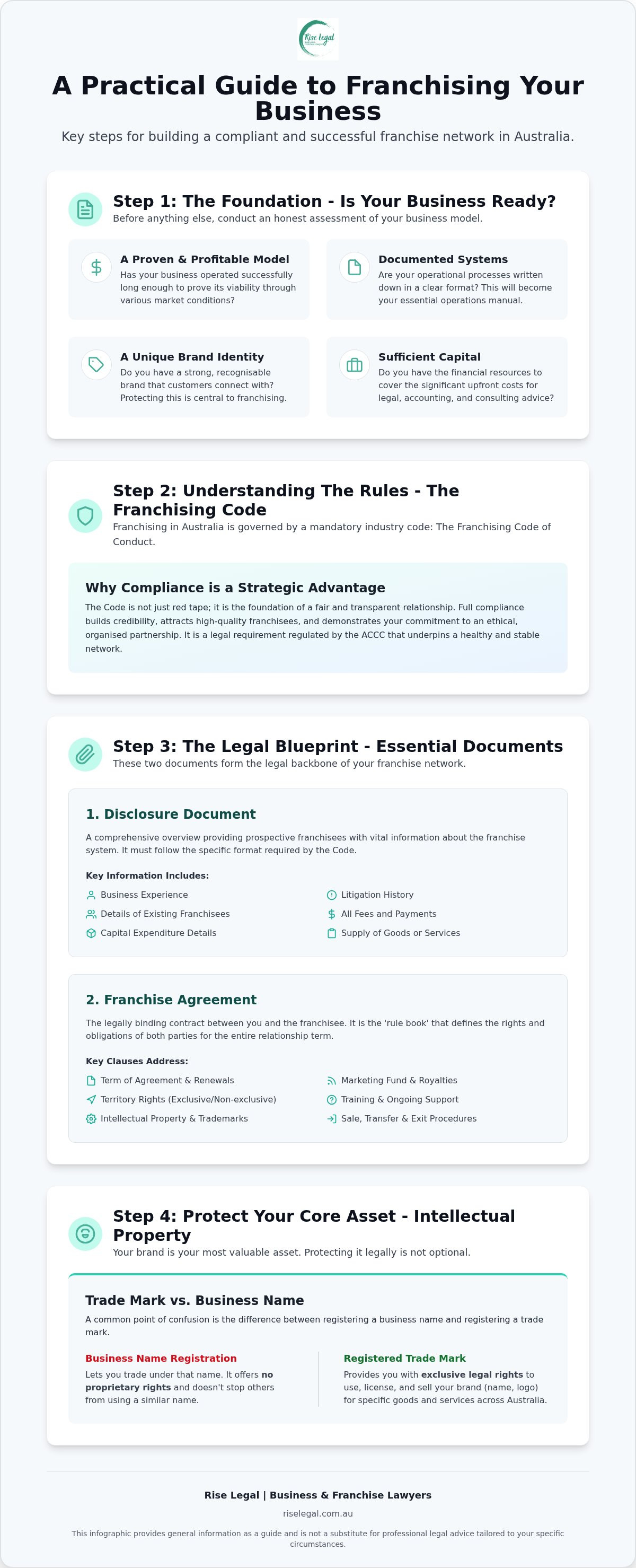
Preparing Your Legal Infrastructure: The Essential Franchise Documents
Once the commercial franchise model has been developed, the legal documentation needs to reflect how the system will actually operate.
A new franchise system will commonly involve a number of documents, including:
- an Information Statement
- a Disclosure Document
- a Franchise Agreement
- a copy of the Franchising Code
- relevant occupancy, lease or related agreements where applicable
- other agreements connected with the franchise arrangement where applicable.
The documents perform different functions and are subject to different requirements under the Code.
The Information Statement
If a prospective franchisee formally applies or expresses an interest in acquiring a franchised business, section 22 of the Code requires the franchisor to give them the prescribed Information Statement.
It must be provided as soon as practicable and no later than 7 days after the person formally applies or expresses interest. It must also be provided before the franchisor gives the prospective franchisee the documents referred to in section 23(2).
The Information Statement provides general information about franchising and matters a prospective franchisee should consider before entering into a franchise arrangement.
The Disclosure Document
The Disclosure Document provides detailed information about the franchisor and franchise system.
Section 20 requires the document to follow the form and content requirements contained in Schedule 1 of the Code.
Depending on the system, the Disclosure Document addresses matters including:
- details of the franchisor and its associates
- business experience
- litigation
- existing and former franchisees
- intellectual property
- territories and sites
- supply arrangements
- establishment costs and other payments
- significant capital expenditure
- specific purpose funds
- financing
- termination rights
- earnings information, if provided
- financial information.
The document is intended to give a prospective franchisee information that assists them in making a reasonably informed decision about entering into the Franchise Agreement.
The Franchise Agreement: Setting the Ground Rules
The Franchise Agreement is the contract governing the relationship between the franchisor and franchisee.
Depending on the franchise model, it may address:
- the term of the agreement
- renewal or extension arrangements
- initial and ongoing fees
- territory rights
- training and support
- operating standards
- approved products and suppliers
- intellectual property licensing
- reporting obligations
- transfers and sales
- default and termination
- restraints
- dispute resolution
- guarantees.
The agreement should reflect how the franchise system will actually operate rather than simply relying on a generic franchise precedent.
The Code also contains specific requirements about terms that may or must appear in Franchise Agreements.
For agreements entered into, transferred, renewed or extended from 1 November 2025, this includes requirements relating to compensation in certain early termination circumstances and a reasonable opportunity for the franchisee to make a return on investment required by the franchisor during the term.
Disclosure Obligations and the 14-Day Consideration Period
The 14-day consideration period is one of the most important timing requirements in the Code.
Under section 23, the franchisor must provide the prospective franchisee with the required documents, including the Franchise Agreement in the form in which it is to be executed, the applicable Disclosure Document and a copy of the Code.
The franchisor must not execute the Franchise Agreement before the end of the 14-day consideration period.
The timing runs from the latest relevant event identified in section 23(6). In some circumstances, a change to the proposed agreement or the later provision of earnings information can cause a new 14-day period to apply.
This is different from the cooling-off regime.
Under section 50, a franchisee entering into a new Franchise Agreement generally has a separate 14-day cooling-off period after entering into the agreement, subject to the exceptions and provisions in that section.
The pre-contract consideration period and post-contract cooling-off period are separate rights.
Protecting Your Brand: Trade Marks and Intellectual Property
When you franchise your business, you are essentially allowing others to operate under your brand and use your intellectual property (IP). Your brand, including your name, logo and reputation, can be an important asset of the franchise system.
Many business owners mistakenly believe that registering a business name with ASIC provides ownership or protection. It does not. A business name registration does not itself provide proprietary rights in the name.
A registered trade mark can provide statutory rights in relation to the registered mark for the specific goods or services covered by the registration. For a franchisor, considering appropriate trade mark protection is an important part of preparing the franchise system.
Why a Business Name Isn’t Enough
Without registered trade mark protection, there may be less certainty around the statutory rights available to protect a brand against conflicting use.
Registering a trade mark with IP Australia can provide statutory rights in relation to the registered mark for the goods and services covered by the registration. Those rights can form an important part of the intellectual property arrangements used in a franchise system.
Rise Legal assists businesses with trade marks and intellectual property.
Managing IP in Contractor and Franchise Agreements
Before establishing a franchise system, it is also worth reviewing intellectual property created by employees, contractors and external suppliers.
This might include:
- websites
- software
- operating manuals
- graphic design
- photography
- written content
- training material
- marketing material.
Paying someone to create material does not necessarily mean every intellectual property right automatically transfers to the business. The relevant employment, contractor and commercial agreements should appropriately address ownership, assignment and licensing.
The Franchise Agreement can then set out the rights granted to franchisees to use relevant intellectual property during the franchise term and what happens to those rights when the agreement ends.
Building a Compliant Franchise System: The Path to Launch
Establishing a franchise system involves legal, commercial, financial and operational work.
A practical process may include the following steps.
Step 1: Assess the Business Model
Review the existing business, financial model, operating systems and capacity to support franchisees.
Consider which parts of the business need to be documented before another person can operate the model.
Step 2: Develop the Franchise Commercial Model
Work through matters such as:
- franchise fees
- royalties
- specific purpose fund contributions, if applicable
- territories
- term
- renewal or extension arrangements
- required investment
- training
- ongoing support
- supply arrangements.
Your accountant or financial adviser should advise on the financial and taxation aspects of the proposed model.
Step 3: Review Your Business Structure
Consider the legal entity or entities through which the franchise system will operate.
There is no single structure that suits every franchisor.
The legal, accounting, taxation and financial implications should be considered with the relevant advisers before the franchise system is established.
Rise Legal can advise on the legal aspects of business structuring, with accounting and taxation advice obtained separately where appropriate.
Step 4: Review and Protect Intellectual Property
Identify the intellectual property used by the business, check ownership and licensing arrangements and consider appropriate trade mark protection.
Step 5: Prepare the Operating System
Document the processes franchisees will need to follow.
Depending on the business, this may include operating manuals, policies, procedures, training material and brand standards.
Step 6: Prepare the Franchise Legal Documents
Prepare the Franchise Agreement, Disclosure Document and related documents around the franchise model that has been developed.
The legal documents should work together with the operational and commercial arrangements rather than being prepared in isolation.
Step 7: Franchise Disclosure Register
A franchisor that is subject to the initial Franchise Disclosure Register requirements must provide the prescribed information for inclusion in the Register in accordance with section 92.
For a franchisor caught by section 92, that information must be provided at least 14 days before entering into the relevant Franchise Agreement.
Section 93 also imposes annual obligations to update or confirm information included, or required to be included, in the Register.
Step 8: Recruit Prospective Franchisees
Once the franchise system is ready, the franchisor can begin recruiting prospective franchisees.
The sales and recruitment process should work with the Code’s disclosure requirements and prescribed time periods.
Step 9: Follow the Required Disclosure Process
Provide the Information Statement and other franchise documents at the required stages.
Keep appropriate records of when documents were provided and any changes made during the process.
Step 10: Complete the Agreement and Onboarding
Once the required consideration period has expired and the parties are ready to proceed, the Franchise Agreement can be executed.
The franchisee can then move through training, establishment and commencement of the franchised business in accordance with the franchise system.
The Rise Legal Approach: Fixed Fees and Upfront Clarity
Rise Legal provides fixed-fee proposals for defined franchise legal work so the scope and agreed cost are clear before work begins.
If you are considering franchising your business, contact Rise Legal about your franchise documents and request a fixed-fee proposal.
Frequently Asked Questions
How much does it cost to franchise my business in Australia?
There is no single cost that applies to every business.
Establishing a franchise system can involve legal work, accounting and financial advice, intellectual property work, development of operating manuals and other commercial costs.
The overall cost will depend on the business, the franchise model and the work required to prepare the system for franchisees.
Rise Legal provides fixed-fee proposals for defined franchise legal work.
Do I need a registered trade mark before I start franchising?
The Franchising Code does not require a franchisor to own a registered trade mark before establishing a franchise system.
However, trade marks can be an important part of protecting the brand used by a franchise network.
Registering a business name with ASIC does not give the business exclusive rights in that name.
A registered trade mark can provide statutory rights in relation to the registered mark for the goods and services covered by the registration.
It is therefore sensible to consider trade mark protection as part of establishing a franchise system.
What is the Franchising Code of Conduct and does it apply to me?
The Franchising Code of Conduct is a mandatory industry code regulating franchise relationships in Australia. It generally applies where an arrangement meets the legal definition of a franchise agreement under section 7, subject to limited exceptions under the Code.
What documents must I give a potential franchisee?
Under the Code, a prospective franchisee must generally receive an Information Statement, the proposed Franchise Agreement, the applicable Disclosure Document and a copy of the Code, together with other relevant documents where required.
The Information Statement must generally be provided as soon as practicable and no later than 7 days after the prospective franchisee formally applies or expresses interest, and before the section 23 documents are provided.
The franchisor generally must not execute the Franchise Agreement until the applicable 14-day consideration period has expired.
Is the 14-day consideration period the same as the cooling-off period?
No.
The 14-day consideration period generally occurs before the franchisor executes the Franchise Agreement.
The Code also contains a separate 14-day cooling-off period that generally applies after a franchisee enters into a new Franchise Agreement.
Different rules can apply in particular circumstances, including certain lease or occupancy arrangements and franchise transfers.
Can I franchise my business without a lawyer?
The Franchising Code does not require a franchisor to use a lawyer to establish a franchise system.
However, the Code imposes detailed disclosure, contractual and procedural obligations, and many provisions are civil penalty provisions.
Franchise Agreements also create significant long-term contractual rights and obligations.
For those reasons, businesses establishing a franchise system commonly obtain legal advice when preparing franchise documents and compliance processes.
Disclaimer
This article provides general information only and does not constitute legal advice. It does not take into account your specific circumstances. Laws and regulatory requirements may change, so you should obtain legal advice relevant to your situation before acting on the information contained in this article. Liability limited by a scheme approved under professional standards legislation.
Share this article using the links below: