

Table of Contents
- What is a Franchise Feasibility Study and Why Does It Matter?
- The 5-Point Franchise Feasibility Assessment Checklist
- Legal Readiness: Compliance with the 2024 Franchising Regulations
- Taking the Next Step: From Business Owner to Franchisor
What is a Franchise Feasibility Study and Why Does It Matter?
Thinking about franchising your business is an exciting step. You’ve built something successful, and now you’re exploring ways to expand your reach. Before investing in franchise documentation and marketing, it can be useful to assess the commercial, operational and legal readiness of the proposed franchise model. This is an assessment of the commercial, operational and legal readiness of the proposed franchise model.
Success in one location doesn’t automatically translate to franchise success. A feasibility assessment can help you consider if the business model is capable of replication, if the financial model appears commercially workable for the franchisor and prospective franchisees, and what legal requirements would apply to the proposed system. It’s a critical process for identifying potential gaps before you commit significant time and resources to expansion.
The Difference Between a Successful Business and a Franchiseable One
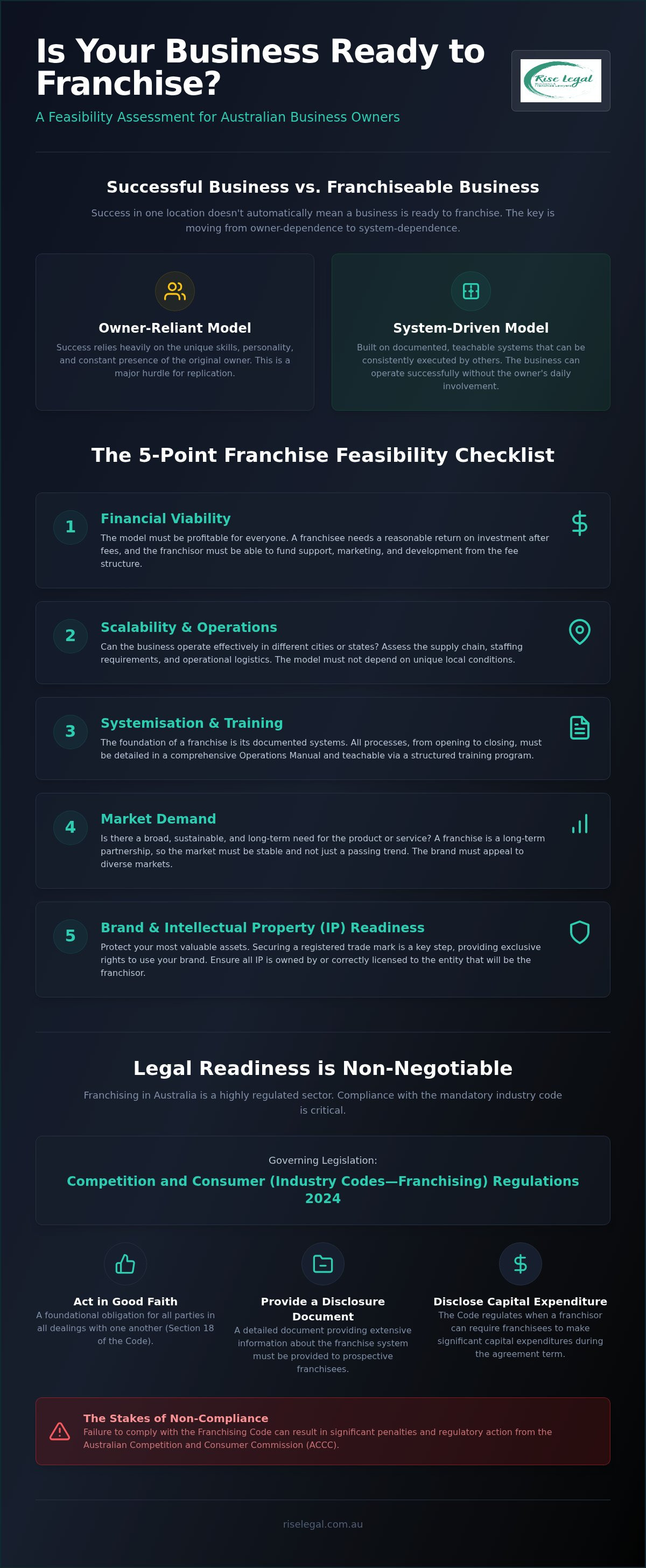
Many successful businesses rely heavily on the unique skills, personality, and constant presence of the original owner. This “owner-operator” factor can be a major hurdle for franchising. The core question to ask is: can the business operate successfully without your personal, day-to-day involvement?
A franchiseable business is built on systems that can be documented, taught, and consistently executed by others. The model needs to be simplified enough that a motivated person can learn to operate it effectively. This process of assessment helps you see your business through the eyes of a potential franchisee and identify what needs to be refined before you can confidently teach someone else to replicate your success.
The 5-Point Franchise Feasibility Assessment Checklist
To determine if your business has what it takes to become a successful franchise, work through this five-point checklist. It covers the key commercial, operational, and legal pillars of a sustainable franchise model.
- Financial Viability: A franchise system must be profitable for everyone involved. Your financial modelling needs to show that after accounting for initial and ongoing franchise fees, a franchisee can still generate a reasonable return on their investment. At the same time, the fee structure must be sufficient to fund your role as a franchisor, which includes providing support, marketing, and ongoing development. The financial model should be assessed to determine if it is commercially workable for all parties.
- Scalability and Operations: Can your business operate just as effectively in a different city or state? This involves looking at your supply chain, staffing, and operational logistics. Can you source the same quality of supplies or raw materials in different regions at a viable cost? Are the skills required to run the business readily available in the broader labour market? A scalable model is not dependent on unique local conditions.
- Systemisation and Training: The foundation of any franchise is its systems. Are your day-to-day processes, from opening procedures to customer service protocols and financial reporting, thoroughly documented? This documentation forms the basis of your Operations Manual, the “how-to” guide for your franchisees. Your systems must be clear, comprehensive, and teachable through a structured training program.
- Market Demand: Is there a broad, long-term need for your product or service, or is it a passing trend? A franchise is a long-term partnership, so you need to be confident that the market for your offering is sustainable. Consider your brand’s positioning and whether it has the potential to appeal to customers in diverse geographical and demographic markets across Australia.
- Brand and Intellectual Property (IP) Readiness: Your brand is one of your most valuable assets. Before franchising, it is worth identifying the intellectual property used in the business and reviewing the relevant ownership, licensing and trade mark arrangements. This involves more than just registering a business name, which does not in itself create proprietary rights. Securing a registered trade mark can form an important part of the franchise system, giving you exclusive rights to use your brand for specific goods or services. You should also review if relevant intellectual property, including trade marks, logos and operational materials, is owned by or appropriately licensed to the entity that will be the franchisor.
Legal Readiness: Compliance with the 2024 Franchising Regulations
Franchising in Australia is a highly regulated sector. The primary legislation you must understand is the Competition and Consumer (Industry Codes—Franchising) Regulations 2024. This is a mandatory industry code made under the Competition and Consumer Act 2010, and compliance is not optional.
Key obligations under the Code include:
- Acting in Good Faith: Section 18 of the Code imposes an obligation to act in good faith on parties to franchise agreements and also applies in certain dealings involving proposed franchise agreements. This is a foundational principle of the franchising relationship.
- Disclosure Document: You must create and provide a detailed Disclosure Document to a prospective franchisee. The Disclosure Document must follow the form and content requirements in the Code and provides detailed information about the franchisor, the franchise system and the proposed franchise arrangement. Where the updating obligation applies, the Disclosure Document generally must be updated within four months from the start of the relevant financial year.
- Significant Capital Expenditure: The Code regulates the circumstances in which a franchisor may require significant capital expenditure during the term of a franchise agreement and contains related disclosure requirements.
The Stakes of Non-Compliance
Failing to comply with the Franchising Code can have serious consequences. Many provisions of the Code are civil penalty provisions, and contraventions can result in regulatory action and significant penalties. The Australian Competition and Consumer Commission (ACCC) is the primary regulator responsible for enforcing the Code.
The Code also establishes a dispute resolution framework, and the Australian Small Business and Family Enterprise Ombudsman can assist parties with accessing alternative dispute resolution processes. Understanding the legal obligations that may apply is an important part of assessing if a business is ready to franchise.
Taking the Next Step: From Business Owner to Franchisor
Becoming a franchisor requires a significant shift in mindset. Your role changes from “doing the work” to mentoring, supporting, and leading others to do the work according to your established systems. It’s a transition from being an operator to being a leader of a network.
To make this transition successfully, it’s important to build a team of experienced advisors, including lawyers, accountants, and potentially a franchise consultant. Each plays a distinct role in helping you prepare for growth, and their advice should be sought to address the different aspects of your business, from financial modelling to legal compliance.
When preparing to establish a new franchise system, legal advice can help you understand the Franchising Code requirements that apply to the proposed arrangement. At Rise Legal, we provide fixed-fee proposals for defined legal work so clients understand the agreed scope and cost before work begins. This approach provides clarity as you manage your initial development costs.
Preparing Your Legal Framework
The legal cornerstones of your franchise system are the Franchise Agreement and the Disclosure Document. These documents should be prepared with the requirements of the Franchising Code in mind and should clearly set out the contractual rights and obligations of the parties.
Depending on the business model, other legal documents may also need to be reviewed, including customer Terms and Conditions, privacy documents, contractor agreements, leases and intellectual property arrangements. Rise Legal provides fixed-fee proposals for defined legal work so the agreed scope and cost are clear before work begins.
Frequently Asked Questions
What is the Competition and Consumer (Industry Codes—Franchising) Regulations 2024?
It is the mandatory industry code that governs the conduct of franchisors, franchisees, and prospective franchisees in Australia. Made under the Competition and Consumer Act 2010, it sets out rules for disclosure, dispute resolution, and the terms of franchise agreements to promote fair and transparent dealings in the sector.
Do I need a feasibility study if my business is already profitable?
Not as a formal legal requirement. The Franchising Code does not require a document formally called a “franchise feasibility study”. However, assessing the financial, operational and legal aspects of the proposed model before investing in franchise documentation can be a useful step when considering franchising.
How long does a franchise feasibility assessment usually take?
The timeframe depends on the complexity of the business, the quality of existing documentation and the amount of financial, operational and legal analysis required. There is no standard timeframe.
What are the main legal risks of franchising a business in Australia?
Franchising can involve legal risks relating to compliance with the Franchising Code, disclosure processes, contractual obligations, intellectual property, leases, supply arrangements and the ongoing franchisor-franchisee relationship. Many provisions of the Code are civil penalty provisions, so it is important for franchisors to understand the requirements that apply to their system.
Can I write my own franchise agreement to save on legal costs?
The Franchising Code does not legally require a franchisor to use a lawyer. However, franchise agreements are complex documents that operate within a detailed and mandatory regulatory framework. They must comply with the Code and other relevant Australian laws. For these reasons, businesses commonly obtain legal advice from lawyers experienced in franchising to assist with drafting their agreements and establishing their system.
Disclaimer
This article provides general information only and does not constitute legal advice. It does not take into account your specific circumstances. Laws and regulatory requirements may change, so you should obtain legal advice relevant to your situation before acting on the information contained in this article. Liability limited by a scheme approved under professional standards legislation.
Share this article using the links below: