
Good Terms & Conditions should reflect the way your business actually operates.
That means more than having a formal-looking document. Your terms should explain what you supply, how customers engage with you, when payment is due, what happens if plans change, and how important risks and responsibilities are allocated.
This practical checklist explains the main areas Australian businesses should consider when preparing or reviewing their Terms & Conditions.
Key Takeaways
- Start with the transaction and customer journey, rather than a generic template.
- Check that your terms clearly deal with scope, ordering, payment, delivery or performance, cancellations, changes and liability.
- Australian Consumer Law protections may apply even where the customer is another business.
- Standard-form contracts may also need to comply with the unfair contract terms regime.
- Gather your quotes, invoices, website wording and customer communications before reviewing or updating your terms.
Table of Contents
- What Terms & Conditions Do
- Which Business Relationship Do Your Terms Cover?
- Terms & Conditions Checklist
- Australian Consumer Law
- Unfair Contract Terms
- Check the Customer Journey
- Before Drafting or Updating Your Terms
- How Rise Legal Can Help
What Terms & Conditions Do
Terms & Conditions set out the rules that apply to a particular commercial relationship or transaction.
They may deal with matters such as:
- who the parties are;
- what goods or services are supplied;
- what each party must do;
- how orders are placed and accepted;
- pricing and payment;
- delivery or performance;
- variations;
- cancellations;
- intellectual property;
- confidentiality;
- liability;
- termination; and
- other rights and obligations relevant to the arrangement.
The wording should reflect the transaction your business actually enters into rather than simply using clauses because they appear in a template.
Website Terms and Sale or Service Terms Are Different
Website-use terms and Terms & Conditions governing a sale or service arrangement serve different purposes.
Website terms may deal with matters such as:
- permitted use of the website;
- website content;
- intellectual property;
- links to other websites; and
- general website disclaimers.
Terms governing the actual sale of goods or supply of services may instead address:
- the goods or services being supplied;
- pricing;
- payment;
- ordering;
- delivery or performance;
- customer responsibilities;
- cancellation; and
- liability and risk.
A website notice alone may not explain the contractual arrangement a customer accepts when placing an order, accepting a quote or engaging your business.
You can read more about Rise Legal’s Terms & Conditions services.
Which Business Relationship Do Your Terms Cover?
Before drafting the document, identify the type of customer and transaction the terms are intended to cover.
Consider:
- whether you deal with consumers;
- whether you deal with other businesses;
- whether you deal with both;
- whether customers buy online;
- whether work is accepted by quote or proposal;
- whether different customer groups receive different pricing or services; and
- whether different sales channels involve different processes.
For example, a business may sell products directly to consumers through an online store while also supplying goods to commercial customers under individual quotes.
Those transactions may involve different ordering, payment, delivery and cancellation arrangements.
One set of Terms & Conditions may not always describe every transaction clearly.
Terms & Conditions Checklist for Your Business
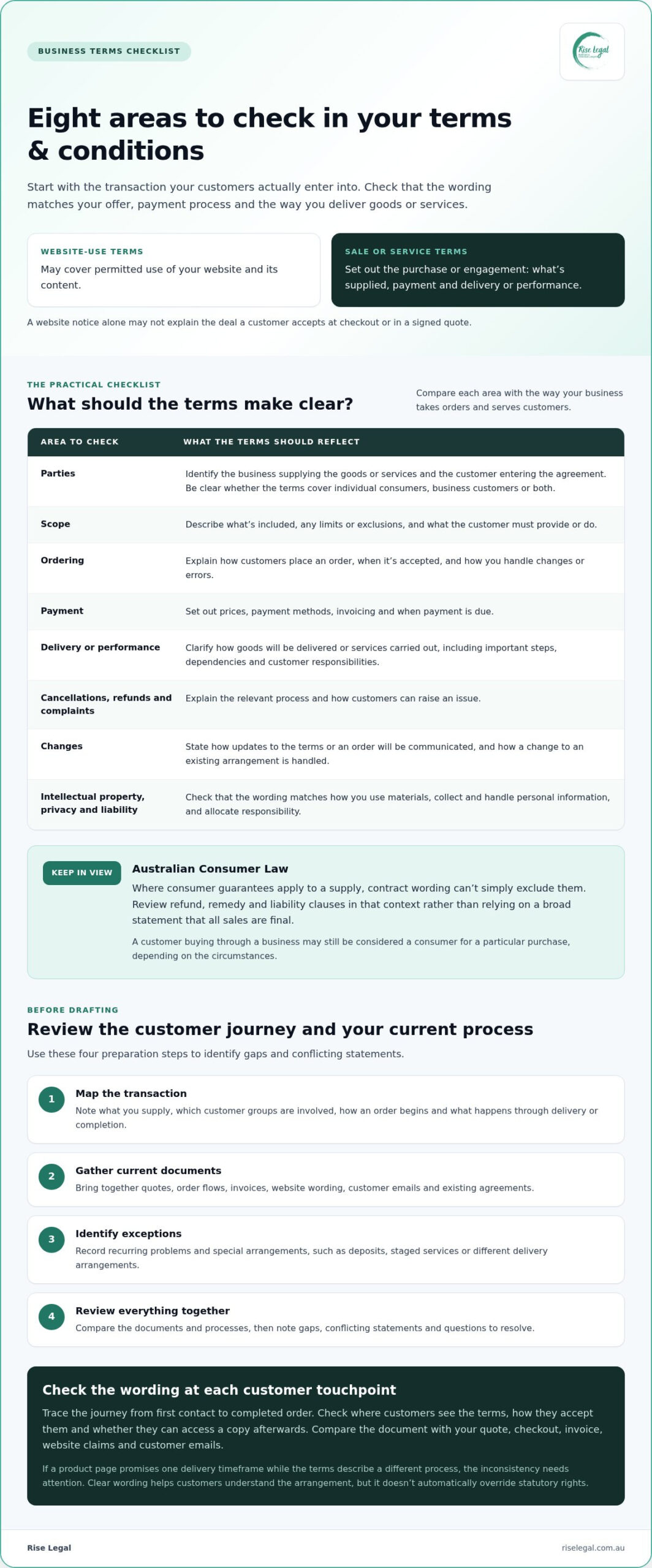
Use the following checklist to test whether your Terms & Conditions reflect the deal your customers actually enter into.
1. Parties
Identify the business supplying the goods or services and the customer entering into the agreement.
Make sure the correct legal entity is named rather than relying only on a trading or business name.
2. Scope
Explain what your business will provide.
This may include:
- goods;
- services;
- deliverables;
- timeframes;
- limitations or exclusions;
- customer responsibilities; and
- things that are specifically outside the agreed scope.
3. Ordering and Acceptance
Explain how a customer places an order or engages your business and when the agreement becomes binding.
This may involve:
- accepting a written quote;
- signing an agreement;
- placing an online order;
- paying a deposit;
- issuing a purchase order; or
- another agreed acceptance process.
4. Payment
Payment clauses may address:
- prices;
- GST;
- deposits;
- invoicing;
- payment methods;
- payment periods;
- late payment;
- interest on overdue amounts;
- debt recovery costs;
- expenses; and
- disputed invoices.
The payment process should match the way your business actually invoices and collects money.
5. Delivery or Performance
Explain how goods are delivered or services are performed.
Relevant issues may include:
- delivery dates or estimated timeframes;
- shipping;
- customer access requirements;
- information the customer must provide;
- dependencies;
- delays;
- approvals; and
- completion or acceptance processes.
6. Cancellations, Refunds and Complaints
Your terms should explain the relevant processes for cancellations, refunds and customer complaints.
These clauses need to be considered alongside any rights that apply under Australian Consumer Law.
A broad statement such as “all sales are final” will not remove statutory consumer rights where those rights apply.
7. Changes and Variations
Explain how changes to an order, project or ongoing arrangement are handled.
This may include:
- who can request a change;
- how the change is approved;
- changes to price;
- changes to timeframes;
- additional work; and
- how amendments are documented.
8. Intellectual Property, Privacy and Liability
Consider how the terms deal with intellectual property, confidential information, personal information and liability.
Depending on the business, this may include:
- ownership of existing intellectual property;
- ownership of newly created material;
- licensing rights;
- use of customer materials;
- confidential information;
- limitations of liability;
- indemnities; and
- specific disclaimers relevant to the goods or services.
Privacy obligations should also be considered separately where your business collects or handles personal information.
Australian Consumer Law
Terms & Conditions must operate alongside any rights that apply under Australian Consumer Law.
Consumer guarantees can apply automatically and cannot simply be removed or contracted out of where they apply.
A customer can also qualify as a consumer even where they are purchasing for business use in certain circumstances.
For example, consumer guarantees may apply to a business purchase where the goods or services cost less than the statutory threshold or are of a kind ordinarily acquired for personal, domestic or household use.
This means businesses should take care with clauses dealing with:
- refunds;
- replacement;
- repair;
- cancellation;
- warranties;
- liability; and
- statements attempting to exclude customer rights.
Unfair Contract Terms
Businesses using standard-form contracts should also consider the unfair contract terms regime.
Australian Consumer Law prohibits proposing, using or relying on unfair terms in certain standard-form consumer and small business contracts.
For contracts entered into or varied from 9 November 2023, small business protections can apply where the business has fewer than 100 employees or annual turnover of less than $10 million.
A term is not automatically unfair simply because it favours one party. The legal test considers matters including whether the term:
- creates a significant imbalance between the parties’ rights and obligations;
- is reasonably necessary to protect the legitimate interests of the party advantaged by it; and
- would cause detriment if applied or relied upon.
This can be relevant to Terms & Conditions dealing with matters such as unilateral changes, automatic renewal, termination, liability and other one-sided contractual rights.
Check the Wording Against the Customer Journey
Terms should be reviewed alongside the way customers actually engage with your business.
Trace the transaction from first contact through to completion.
Ask:
- Where does the customer first see the terms?
- How are the terms provided?
- How does the customer accept them?
- Can the customer access a copy afterwards?
- Does the quote match the terms?
- Does the website match the terms?
- Do invoices contain inconsistent wording?
- Do staff emails promise something different?
For example, if your website promises delivery within a particular timeframe but your Terms & Conditions describe a different process, that inconsistency should be addressed.
The written terms should reflect the actual customer experience as closely as practicable.
Before Drafting or Updating Your Terms
Before preparing new Terms & Conditions or asking for an existing document to be reviewed, gather information about how your business operates.
1. Map the Transaction
Write down:
- what you supply;
- who your customers are;
- how they place an order;
- when the order is accepted;
- how payment works;
- how goods or services are supplied; and
- how the transaction ends.
2. Gather Current Documents
Bring together relevant documents and communications, such as:
- existing Terms & Conditions;
- quotes;
- proposals;
- order forms;
- invoices;
- website wording;
- checkout wording;
- customer emails; and
- other agreements used in the sales process.
3. Identify Exceptions
Consider circumstances where your normal process changes.
For example:
- some customers pay deposits;
- some projects are delivered in stages;
- certain customers receive different payment terms;
- special-order goods cannot easily be resold;
- delivery arrangements differ between customers; or
- staff regularly agree to variations by email.
These exceptions can be important when deciding what the terms need to address.
4. Review Everything Together
Compare your current documents, website wording and internal processes.
Look for:
- gaps;
- contradictory wording;
- outdated processes;
- terms that no longer reflect your business;
- customer issues that regularly arise; and
- areas that staff deal with differently in practice.
This helps identify what should be clarified before the new wording is prepared.
When Should You Review Your Terms & Conditions?
Terms & Conditions should be reviewed when there is a meaningful change to how your business operates.
This may include:
- introducing a new product or service;
- changing your payment model;
- adding subscriptions;
- changing cancellation arrangements;
- changing delivery processes;
- adding a new sales channel;
- starting online sales;
- changing the legal entity operating the business;
- changing how intellectual property is handled; or
- repeatedly encountering the same customer issue.
Regular review can also help identify clauses that no longer reflect current business practices.
How Rise Legal Can Help
Rise Legal assists Australian businesses with drafting and reviewing commercial Terms & Conditions.
Our work can include preparing terms dealing with matters such as:
- scope of goods or services;
- payment terms;
- late payment;
- customer responsibilities;
- variations;
- delivery or performance;
- cancellations;
- intellectual property;
- confidentiality;
- termination;
- liability; and
- other commercial provisions relevant to the business.
Rise Legal provides fixed-fee proposals for defined legal work, so the scope and professional fee are agreed before work begins.
Rise Legal focuses on commercial and business law and does not undertake disputes or litigation.
Contact Rise Legal to request a fixed-fee proposal for Terms & Conditions advice or drafting.
Frequently Asked Questions
Are Terms & Conditions legally binding in Australia?
They can form part of a legally binding agreement where they have been properly incorporated into the contract and accepted by the parties.
The circumstances matter, including when and how the terms were provided and how the agreement was formed.
Contract terms can also be affected by legislation including Australian Consumer Law.
Can I use a free Terms & Conditions template?
A template may provide a starting point, but it may not reflect your business, customer groups, ordering process or commercial risks.
A template may also contain provisions that do not match your actual operations or omit matters that are important to your business.
Do Australian businesses need Terms & Conditions on their websites?
There is no universal requirement for every Australian business website to display a standalone Terms & Conditions page.
However, businesses selling goods or services online should consider how customers are given access to the contractual terms and how those terms are accepted.
Website-use terms, transaction terms and privacy documentation may also deal with different issues.
Can my Terms & Conditions say “no refunds”?
Businesses should be cautious with blanket “no refunds” statements.
Where Australian Consumer Law rights apply, a business cannot remove those statutory rights simply by including contrary wording in its Terms & Conditions.
Do Australian Consumer Law protections apply to business customers?
Potentially.
A business can still be considered a consumer for a particular purchase in certain circumstances, including where the statutory criteria are satisfied.
What are unfair contract terms?
Unfair contract terms laws can apply to standard-form consumer and small business contracts.
Businesses should consider whether their standard terms create an unjustified imbalance between the parties or impose rights that go further than reasonably necessary to protect legitimate business interests.
When should I update my Terms & Conditions?
Consider reviewing your terms when your products, services, payment model, customer journey or business processes change.
A review can also be useful if customers regularly misunderstand a particular clause or staff routinely make arrangements that do not match the written document.

Article by
Helen Kay, Principal Lawyer, Rise Legal
Helen Kay is the Managing Director and Principal Lawyer at Rise Legal, an Australian commercial and business law firm advising business owners, franchisors and franchisees across Australia. Helen practises in commercial law, franchising, business contracts, business sales and purchases, trade marks and related business law matters.
Disclaimer
This article provides general information only and does not constitute legal advice. It does not take into account your specific circumstances. Laws and regulatory requirements may change, so you should obtain legal advice relevant to your situation before acting on the information contained in this article. Liability limited by a scheme approved under professional standards legislation.