

Table of Contents
- Why Due Diligence is Your Best Business Partner
- The Legal Checklist: What the 2024 Regulations Require
- The Commercial Checklist: Beyond the Paperwork
- Turning Your Checklist into Action: The Review Process
Why Due Diligence is Your Best Business Partner
Entering a franchise agreement is a significant commercial decision. Before you commit your capital and time, it’s essential to conduct thorough due diligence. This is the process of investigating and verifying the information provided by the franchisor to make an informed choice.
In Australia, due diligence isn’t just good business practice; it’s a process supported by a mandatory legal framework. The Competition and Consumer (Industry Codes—Franchising) Regulations 2024 (the Code) sets out specific rights and obligations for everyone involved. A careful check helps you understand the business model, the brand’s reputation, and the financial aspects of the franchise system.
Ultimately, this process allows you to approach negotiations from a position of knowledge and clarity, setting a strong foundation for your new business.
The Mandatory Nature of the Franchising Code
The Franchising Code is not optional. It is a mandatory industry code made under the Competition and Consumer Act 2010 that governs the conduct of franchisors, franchisees, and prospective franchisees in Australia.
A key principle of the Code is the obligation for all parties to act in good faith in their dealings with one another (Section 18). This duty is fundamental to the franchising relationship and cannot be excluded or limited by any clause in your franchise agreement.
The Legal Checklist: What the 2024 Regulations Require
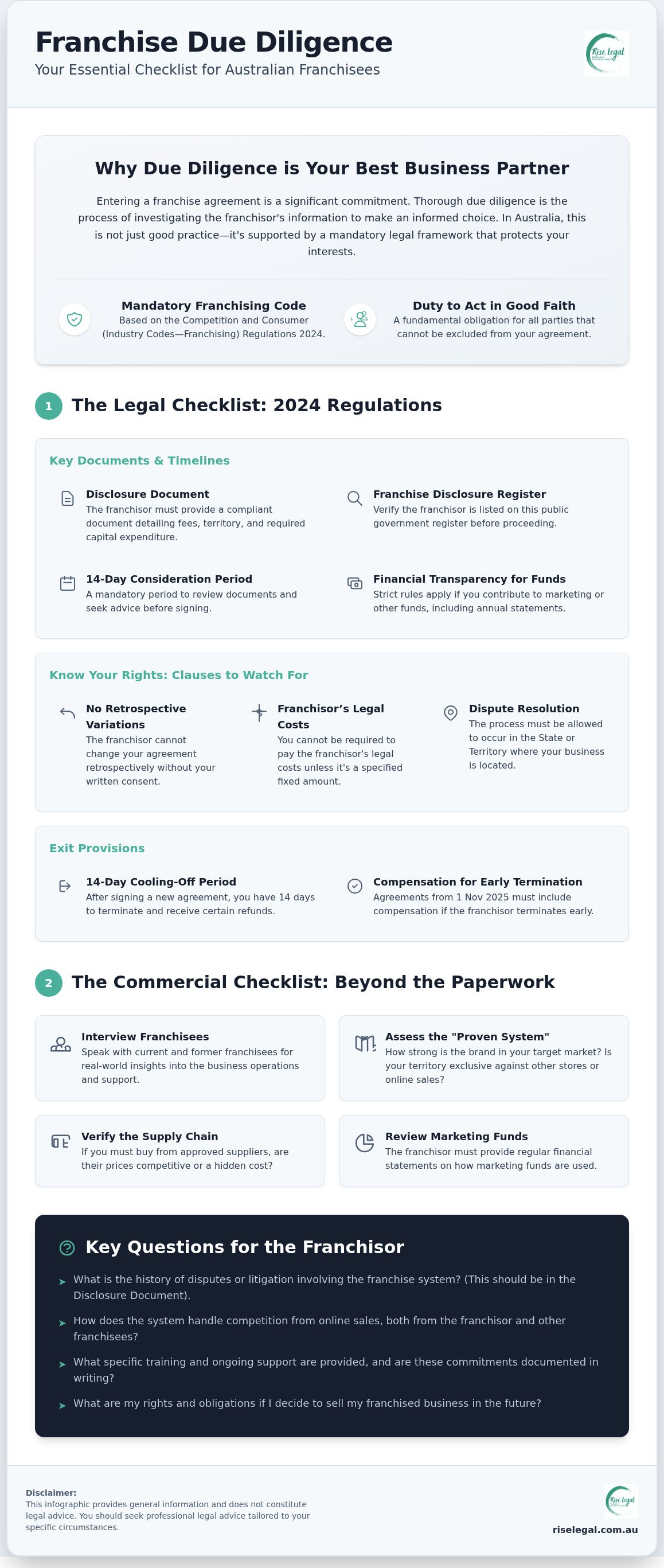
The Franchising Code provides a framework of disclosure and conduct rules. Your legal due diligence should start by checking the franchisor’s compliance with these key requirements.
- The Disclosure Document: The franchisor must give you a Disclosure Document that complies with the form and content requirements of Schedule 1 of the Code. It should detail critical information about the franchise, including fees, territory, supply arrangements, and any significant capital expenditure you may be required to make.
- The Franchise Disclosure Register: You should verify that the franchisor is listed on the Franchise Disclosure Register. This is a public, searchable register managed by the Australian Government.
- The Consideration Period: Under Section 23 of the Code, a franchisor must not enter into, renew or extend a franchise agreement until at least 14 days after you have been given the required disclosure documents. This period is designed to give you time to consider the opportunity and seek professional advice.
- Financial Transparency for Funds: If you are required to contribute to a marketing or other cooperative fund (known as a specific purpose fund), the Code has strict rules. The franchisor must prepare an annual financial statement for the fund, have it audited in most cases, and provide you with a copy (Sections 31-32).
Know Your Rights: Clauses to Watch For
The Code prohibits certain unfair terms from being included in franchise agreements. As you review the documents, be aware of these key protections:
- Retrospective Variations: A franchisor cannot vary your agreement to apply retrospectively without your written consent (Section 62).
- Franchisor’s Legal Costs: The agreement cannot require you to pay the franchisor’s legal costs for preparing, negotiating, or executing the agreement, unless it is a specified, fixed dollar amount that does not exceed the franchisor’s reasonable and genuine legal costs (Section 38).
- Dispute Resolution: Any dispute resolution clause must allow for the process to occur in the State or Territory where your franchised business is located (Section 40).
Cooling-Off and Early Termination Provisions
The Code provides important rights regarding the conclusion of your agreement, whether it’s by your choice shortly after signing or due to an early termination by the franchisor.
- Cooling-Off Period: You have a 14-day cooling-off period after entering into a new franchise agreement (Section 50). This allows you to terminate the agreement and receive a refund of certain payments.
- Compensation and Return on Investment: For relevant agreements entered into, transferred, renewed or extended from 1 November 2025, section 43 requires franchise agreements to contain compensation provisions for certain specified early termination circumstances. Section 44 separately requires the agreement to provide the franchisee with a reasonable opportunity to make a return during the term on investment required by the franchisor. Different provisions apply to new vehicle dealership agreements.
The Commercial Checklist: Beyond the Paperwork
Legal compliance is only one part of the picture. Your due diligence must also assess the commercial viability and operational reality of the franchise system.
- Interview Current and Former Franchisees: The Disclosure Document must include contact details for other franchisees. Speaking with them can provide invaluable, real-world insights into the business. Be aware that former franchisees may request that their details are not disclosed.
- Assess the “Proven System”: How strong is the brand in your target market? Does the franchise agreement grant you an exclusive territory, or could the franchisor set up another store or online business that competes directly with you?
- Verify the Supply Chain: Are you required to purchase goods or services from the franchisor or their approved suppliers? If so, research whether these prices are competitive or if they represent a hidden cost.
- Review Marketing and Other Funds: If you contribute to a marketing fund, the franchisor must provide regular financial statements explaining how that money is being used. The Code regulates the use of these funds and requires transparency.
Operational Questions for the Franchisor
When you meet with the franchisor, have a list of practical questions ready. Their answers (or lack thereof) can be very revealing.
- What is the history of disputes or litigation involving the franchisor? This information should be disclosed in the Disclosure Document (Schedule 1).
- How does the franchise system handle competition from online sales, both from the franchisor and other franchisees?
- What specific training and ongoing support are provided, and are these commitments documented in writing?
- What are your rights and obligations if you decide to sell your franchised business in the future?
Turning Your Checklist into Action: The Review Process
Once you have gathered information from your legal and commercial checks, it’s time to bring it all together and make a decision.
- Collate Your Findings: Organise your notes from document reviews and interviews with franchisees. Identify any inconsistencies, concerns, or areas that require further clarification.
- Seek Independent Professional Advice: Before entering into the Franchise Agreement, the Code contains requirements concerning statements about independent legal, business and accounting advice. Prospective franchisees should consider obtaining legal advice on the franchise documents and separate accounting or business advice on the financial and commercial aspects of the opportunity.
- Identify Red Flags: A legal review should focus on identifying clauses that may be inconsistent with the Franchising Code or that place an unreasonable level of risk on you.
- Request Clarifications or Amendments: Based on your review, you can ask the franchisor to clarify or amend certain terms. While a franchisor is not generally obligated to make changes, their willingness to discuss your concerns can be a good indicator of the future working relationship.
The Rise Legal Approach: Fixed-Fee Reviews
Navigating the complexities of a franchise agreement can be a daunting process. At Rise Legal, we provide straightforward legal advice to help franchisees understand their rights and obligations under the Code.
We offer fixed-fee reviews, which means we provide you with an upfront price for our services. This gives you certainty and allows you to budget for professional advice without worrying about unexpected legal bills.
A professional franchise legal review can help you assess whether the agreement aligns with the 2024 Regulations and your commercial goals. Feel free to contact us to request a fixed-fee proposal.
Frequently Asked Questions
What is the most important document in the franchisee due diligence process?
The Disclosure Document is arguably the most critical document. It is the franchisor’s formal statement providing key information about the franchise system, as required by the Franchising Code. You should review it carefully with your legal and financial advisers.
Can a franchisor change the agreement after I have signed it?
Generally, a franchisor cannot vary the terms of the franchise agreement retrospectively without your written consent (Section 62 of the Code). However, franchise systems evolve. The agreement may permit the franchisor to update its operational manual or other system procedures, which you would then be required to follow. These prospective changes should be reasonable and consistent with the overall agreement.
How much time do I have to review the franchise agreement before signing?
The Franchising Code generally provides a 14-day consideration period before the franchisor can execute the Franchise Agreement. The period runs from the latest relevant event specified in section 23, including the provision of the required documents and, in some circumstances, later changes to the agreement or earnings information. A prospective franchisee may make a payment during the consideration period, subject to the repayment provisions in the Code.
What happens if the franchisor breaches the Franchising Code?
The Franchising Code is legally enforceable. Many breaches of the Code are subject to significant civil penalties. The Australian Competition and Consumer Commission (ACCC) is responsible for investigating complaints and taking enforcement action. Franchisees may also have private rights of action against a franchisor for a breach.
Do I have to pay the franchisor’s legal fees for preparing the agreement?
Under Section 38 of the Code, a franchisor cannot require you to pay their legal costs associated with preparing, negotiating, or executing the agreement unless those costs are for a specified fixed amount stated in the agreement and are reasonable.
Disclaimer
This article provides general information only and does not constitute legal advice. It does not take into account your specific circumstances. Laws and regulatory requirements may change, so you should obtain legal advice relevant to your situation before acting on the information contained in this article. Liability limited by a scheme approved under professional standards legislation.
Share this article using the links below: