

Franchise Royalties and Fees in Australia: What Franchisees Should Know
Franchise royalties and fees can have a significant effect on the profitability of a franchised business.
The headline royalty percentage is only part of the picture. Franchisees may also be required to pay marketing contributions, technology fees, training costs, minimum payments and other charges during the term of the franchise.
The way those payments are defined in the franchise agreement can matter just as much as the percentage or dollar amount itself.
Before entering a franchise, it is important to understand the overall fee structure and how those obligations may affect the business over time.
Key Takeaways
- The initial franchise fee and ongoing royalties are different costs.
- A royalty percentage does not tell you the whole cost of operating within a franchise system.
- Marketing, technology, training and other charges may be payable separately.
- Some franchise agreements include minimum royalties or mechanisms allowing fees to change.
- The franchise agreement and disclosure document should be considered together.
- Ongoing fees can materially affect the profitability and cash flow of the franchised business.
What Are Franchise Royalties?
Franchise royalties are recurring payments made by a franchisee under the franchise agreement.
They commonly relate to the franchisee’s continued participation in the franchise system, including the right to operate using the franchisor’s brand, intellectual property and business systems.
Royalties may also reflect access to ongoing support and other aspects of the franchise network.
The precise obligation depends on the franchise agreement.
Initial Franchise Fees and Ongoing Royalties Are Different
The initial franchise fee is generally a one-off payment associated with joining the franchise system.
Ongoing royalties continue during the franchise relationship.
These should be considered separately because paying an initial franchise fee does not necessarily cover all of the costs involved in establishing or operating the business.
Other expenses may include:
- fit-out costs;
- equipment;
- stock;
- lease costs;
- training;
- technology;
- marketing contributions;
- insurance;
- professional fees; and
- other operating costs.
The ACCC requires franchisors to provide prospective franchisees with a disclosure document containing information about the costs of setting up and operating the franchise.
You can read the ACCC’s current guidance on franchise disclosure documents.
The Headline Royalty Rate Does Not Tell the Whole Story
A franchise opportunity may advertise or disclose a royalty as a percentage of sales or as a fixed amount.
That figure alone does not necessarily tell you how significant the obligation will be.
The commercial effect can depend on matters such as:
- what revenue the agreement treats as sales;
- when the royalty becomes payable;
- any minimum payment requirements;
- additional franchise fees;
- marketing contributions;
- technology charges;
- annual increases; and
- other payment obligations.
This is why the complete fee structure should be considered rather than focusing on a single percentage.
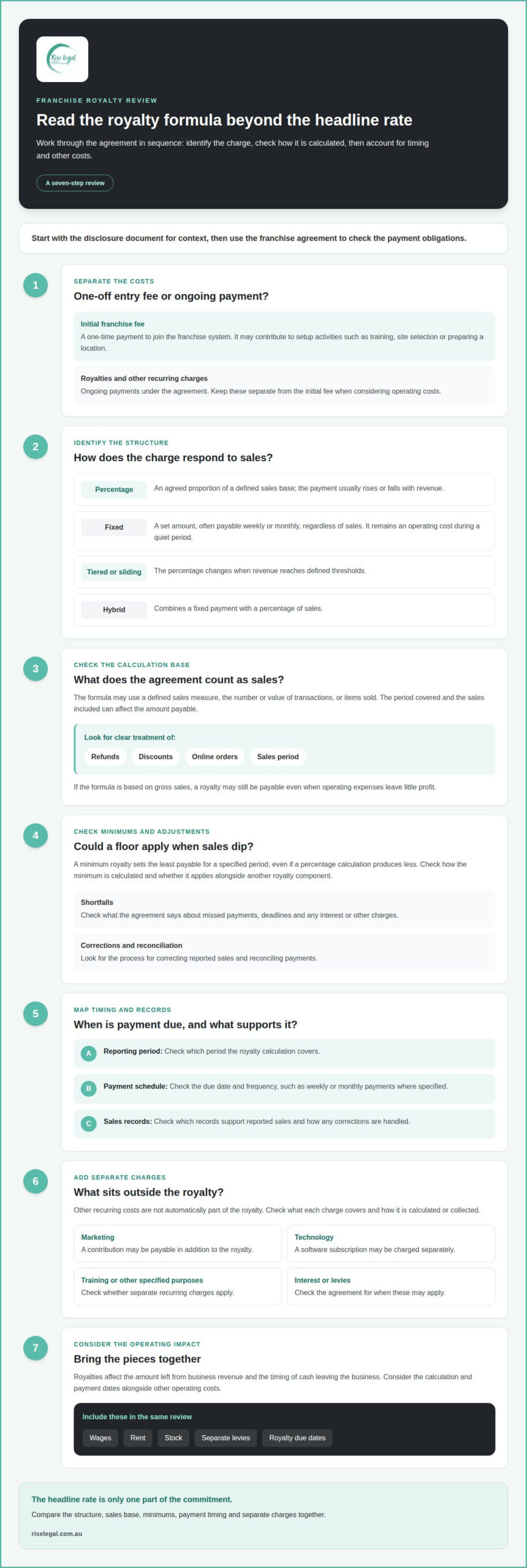
How Can Franchise Royalties Be Structured?
Franchise systems use different royalty structures.
Common approaches include:
- percentage-based royalties;
- fixed recurring fees;
- minimum royalties;
- tiered structures; and
- arrangements combining more than one method.
Each structure can affect a franchisee differently depending on the performance of the business.
For example, a percentage-based royalty may increase as sales increase, while a fixed or minimum royalty can remain payable even during weaker trading periods.
The important issue is how the particular structure affects the economics of the franchise over the full term of the agreement.
What Does “Gross Sales” Mean?
Many franchise agreements calculate royalties by reference to a defined sales figure.
The meaning of that term can have a significant impact on the amount payable.
The definition may deal with matters such as online sales, discounts, refunds, delivery charges or other forms of revenue.
Two franchise agreements could therefore contain the same headline royalty percentage but produce different financial outcomes because the underlying definition of sales is different.
This is one of the reasons the wording of the agreement matters, rather than simply comparing advertised royalty percentages.
Minimum Royalties Can Change the Risk
Some franchise agreements include a minimum royalty or minimum periodic payment.
This means the franchisee may remain liable for a specified amount even where sales are lower than expected.
That can become commercially significant during:
- slow trading periods;
- the early stages of the business;
- economic downturns;
- unexpected closures; or
- other periods where revenue falls.
The effect of any minimum payment should be considered alongside projected revenue and the other fixed costs of operating the business.
Marketing and Advertising Contributions
Marketing contributions are often separate from franchise royalties.
A franchisee may therefore pay both an ongoing royalty and a separate contribution towards advertising, marketing or another specific-purpose fund.
Under the current Franchising Code, additional disclosure obligations apply where franchisees contribute to a specific-purpose fund.
The ACCC explains that disclosure documents must include prescribed information about these funds and how they operate. See the ACCC’s disclosure guidance.
Franchisees should not assume that a marketing contribution is included within the royalty unless the documents make that clear.
Technology, Training and Other Ongoing Fees
Franchise systems increasingly rely on centralised technology, software, booking platforms, point-of-sale systems and other network services.
Franchise agreements may require franchisees to pay separate fees associated with these systems.
Other recurring or occasional charges may relate to:
- training;
- software;
- renewal;
- transfer;
- audits;
- conferences;
- administration; or
- other network services.
These fees may individually look relatively small, but collectively they can have a material effect on the cost of operating the franchise.
Can Franchise Fees Increase?
Some franchise agreements allow certain fees to increase during the term.
The mechanism may depend on the particular agreement and could involve fixed increases, indexation or another adjustment process.
A prospective franchisee should understand not only what the fees are at commencement, but also how they may change over time.
This is particularly important where the agreement has a long term or where a franchisee is making a significant upfront investment.
Why Cash Flow Matters
Royalties and franchise fees are operating expenses.
Where a royalty is calculated on sales rather than profit, it may remain payable even when wages, rent, stock and other costs leave the business with a small profit or a loss.
This means turnover alone does not tell a prospective franchisee what they may ultimately earn from the business.
The ACCC’s current guidance also reflects the importance of franchise economics. Franchise agreements entered into, renewed or extended on or after 1 November 2025 must give franchisees a reasonable opportunity to make a return on investments required by the franchisor during the agreement term.
Why the Disclosure Document Matters
The franchise disclosure document is designed to give prospective franchisees important information about the franchise system.
It includes information about costs of setting up and operating the franchise, supply arrangements and other matters relevant to the investment.
From 1 November 2025, franchisors also have expanded obligations relating to significant capital expenditure and specific-purpose funds.
The disclosure document should be considered alongside the franchise agreement rather than viewed as a substitute for it.
The agreement creates the contractual obligations between the parties, while the disclosure document provides important information about the franchise system and proposed investment.
Franchise Fees and Significant Capital Expenditure
Ongoing royalties are not the only future financial commitments that can affect franchise profitability.
A franchisee may also be required to incur significant capital expenditure during the franchise term.
Under the current Franchising Code, franchisors must disclose prescribed information about significant capital expenditure that franchisees may be required to incur and discuss that expenditure with prospective franchisees.
This can include expenditure associated with matters such as refurbishments, equipment or changes required by the franchise system.
These commitments should be considered alongside royalties and recurring fees when assessing the overall cost of the opportunity.
The Franchise Agreement Sets the Legal Obligation
The franchise agreement is the contract governing the relationship between franchisor and franchisee.
The ACCC describes it as the most important document in the franchising relationship.
Among other matters, it should address the fees the franchisee is required to pay and the rights and obligations of the parties.
You can read more about the current requirements on the ACCC’s franchise agreement guidance.
The agreement should therefore be reviewed as a whole rather than assessing royalty clauses in isolation.
Why Independent Advice Matters
The financial effect of a franchise involves both legal and financial considerations.
A franchise lawyer can advise on the contractual obligations contained in the franchise agreement and how they interact with the disclosure material and Franchising Code.
An accountant or financial adviser can separately assess projected profitability, cash flow and the financial viability of the proposed business.
These are different roles and one does not replace the other.
Franchise Lawyers Australia
Rise Legal assists franchisees and franchisors across Australia with franchise agreements and franchising legal advice.
For prospective franchisees, we can review the franchise agreement and disclosure material and explain the legal effect of the royalty, fee and payment provisions before you commit.
We also advise franchisors on preparing and reviewing franchise documentation and complying with the current Franchising Code.
Our franchising services are provided on a fixed-fee basis, with the scope and professional fee agreed upfront.
If you are considering buying a franchise or reviewing an existing franchise arrangement, contact Rise Legal to discuss the legal documents.
Frequently Asked Questions
What are franchise royalties?
Franchise royalties are recurring payments required under a franchise agreement. The amount and calculation method depend on the particular franchise system and agreement.
Are franchise royalties usually based on sales or profit?
Many franchise systems calculate royalties by reference to sales or another defined revenue measure rather than profit. Other systems may use fixed, minimum or combined fee structures. The agreement determines the actual obligation.
Is a marketing fee the same as a franchise royalty?
Not necessarily. Marketing or advertising contributions may be separate payment obligations in addition to the franchise royalty.
Can a franchise royalty increase during the agreement?
Potentially. Some agreements contain mechanisms allowing particular fees to increase or change during the franchise term. The relevant provisions should be considered before signing.
Are franchise royalties payable when the business is not profitable?
Potentially. If the royalty is based on sales or includes a minimum payment, an amount may remain payable even where the franchisee makes little or no profit.
Where should franchise fees be disclosed?
The franchise agreement sets out the contractual payment obligations. The disclosure document must also contain prescribed information about the costs of establishing and operating the franchise and other relevant financial matters.
Should I get legal advice about franchise royalties?
Independent legal advice can help you understand the contractual effect of royalty provisions, other franchise fees and related obligations. Financial and accounting advice should separately be obtained about profitability, cash flow and the commercial viability of the franchise.

Article by Helen Kay, Principal Lawyer, Rise Legal
Helen Kay is the Managing Director and Principal Lawyer at Rise Legal, an Australian commercial and business law firm advising business owners, franchisors and franchisees across Australia. Helen practises in commercial law, franchising, business contracts, business sales and purchases, trademarks and related business law matters.
Disclaimer
This article provides general information only and does not constitute legal advice. It does not take into account your specific circumstances. Laws and regulatory requirements may change, so you should obtain legal advice relevant to your situation before acting on the information contained in this article. Liability limited by a scheme approved under professional standards legislation.