

Selling a Franchise in Australia: What Franchisees Need to Know
The franchise resale process in Australia involves more than finding a buyer and agreeing on a price.
Your franchise agreement, the Franchising Code of Conduct, the franchisor's transfer requirements and the business sale itself can all affect whether the transaction proceeds and when settlement can occur.
Franchisor approval is particularly important. Under the current Franchising Code, a franchisor must not unreasonably withhold consent to a transfer.
This article explains the main issues franchisees should understand before putting a franchised business on the market.
Key Takeaways
- Selling a franchise usually requires the franchisor's involvement and consent.
- The franchise agreement may impose conditions on a transfer.
- The franchisor must not unreasonably withhold consent under the Franchising Code.
- Transfer fees, training requirements, lease arrangements and other conditions can affect the transaction.
- The buyer may have cooling-off rights under the Franchising Code.
- Getting legal advice early can help identify issues that may affect the sale before a buyer becomes committed.
Can You Sell a Franchise Business?
Yes. Franchisees can generally sell their franchised business, subject to the terms of their franchise agreement and the Franchising Code.
However, a franchise resale differs from the sale of an ordinary independent business because the franchisor remains part of the process.
The franchisor may have contractual rights regarding:
- the proposed buyer;
- transfer approval;
- training;
- outstanding amounts;
- premises requirements;
- transfer documentation; and
- other conditions that must be satisfied before completion.
Those requirements can affect both the timing and commercial terms of the sale.
Why the Franchise Agreement Matters
The franchise agreement should be reviewed before the business is marketed or a sale is agreed.
Transfer provisions may affect:
- how consent is requested;
- what criteria an incoming buyer must satisfy;
- what fees are payable;
- what happens to the existing franchise agreement;
- training or onboarding requirements;
- premises or refurbishment obligations; and
- other conditions applying to the proposed transfer.
Understanding those provisions early can reduce the risk of agreeing to a transaction that cannot be completed on the expected terms.
Does the Franchisor Need to Approve the Buyer?
In most franchise resales, the franchisor will be involved in assessing the proposed incoming franchisee.
Under the current Franchising Code, a person may request in writing that the franchisor consent to the transfer of a franchise agreement.
The franchisor must advise in writing whether consent is given and, if consent is refused, provide reasons.
Importantly, the franchisor must not unreasonably withhold consent.
The Code recognises circumstances in which withholding consent may be reasonable, including where the proposed buyer does not meet reasonable selection criteria or is unlikely to meet the financial obligations under the franchise agreement.
You can read the ACCC's current guidance on selling or transferring a franchise agreement.
What Is the 42-Day Franchise Transfer Rule?
The Franchising Code includes an important timing rule for transfer consent.
If the franchisor does not advise the person in writing that consent is refused within 42 days of the later of:
- the date the transfer request is made; or
- where further information is requested, the date the last of that information is provided,
the franchisor is taken to have consented to the transfer.
Where consent arises in this way, the Code provides that the deemed consent cannot then be revoked under the ordinary revocation provision.
This does not mean every franchise resale will take 42 days. It is a statutory rule dealing with the franchisor's response to a transfer request, not a guaranteed transaction timeframe.
Can a Franchisor Revoke Consent?
In some circumstances, yes.
Where a franchisor has expressly granted consent, the Code permits consent to be revoked within 14 days if the franchisor advises the relevant person in writing and gives reasons.
However, the franchisor must not unreasonably revoke consent.
This is different from consent that arises automatically because the franchisor did not refuse the transfer within the 42-day period.
Can Franchise Transfer Fees Apply?
Potentially.
A franchise agreement may provide for an assignment or transfer fee when a franchise is sold.
Other costs may also arise in connection with matters such as:
- training the incoming franchisee;
- preparing transfer documents;
- updating premises;
- landlord consent;
- lease assignment;
- professional fees; and
- other transaction requirements.
These costs should be understood before the parties settle on the commercial terms of the sale.
What Happens to the Franchise Agreement?
The legal structure of the transfer can vary.
A transaction may involve the transfer of an existing franchise agreement or the incoming buyer entering into a new franchise agreement with the franchisor.
That distinction matters because the buyer may not simply acquire every right the seller currently has.
The incoming franchisee may have different:
- fees;
- agreement terms;
- renewal rights;
- territory arrangements;
- restraints;
- refurbishment requirements; or
- other obligations.
The structure should therefore be understood before the seller and buyer assume that the existing arrangement will continue unchanged.
Does the Buyer Have a Cooling-Off Period?
The current Franchising Code provides cooling-off rights for franchise buyers.
The way those rights apply depends on whether the buyer enters into a new franchise agreement or takes a transfer of an existing agreement.
For a transferred existing franchise agreement, the Code provides a specific cooling-off regime that can allow the incoming franchisee to cease being the franchisee and, where applicable, terminate the transfer agreement.
The applicable timing and requirements should be considered as part of the transaction because they can affect the sale timetable and completion arrangements.
What Happens to the Lease?
If the franchised business operates from leased premises, the lease may be another significant part of the transaction.
The sale may involve:
- assignment of an existing lease;
- landlord consent;
- a new lease;
- new guarantees or security;
- premises works; or
- other landlord requirements.
The lease and franchise agreement should be considered together because a problem with one can affect the viability of the other.
What Happens to Employees?
A franchise resale may also involve employees continuing with the business under a new owner.
The treatment of employees depends on the transaction structure and applicable workplace laws.
Issues can include:
- offers of employment;
- recognition of service;
- employee entitlements;
- applicable awards or enterprise agreements; and
- the Fair Work transfer-of-business provisions.
These matters should be addressed in the sale arrangements rather than left until settlement.
What Other Contracts May Be Affected?
The franchise agreement is not necessarily the only contract relevant to the sale.
The business may also have:
- supplier agreements;
- equipment leases;
- finance arrangements;
- customer contracts;
- software subscriptions;
- licences; and
- other commercial agreements.
Some may transfer, some may require consent and others may remain with the seller.
The transaction documents should clearly identify what the buyer is acquiring and what obligations remain with the seller.
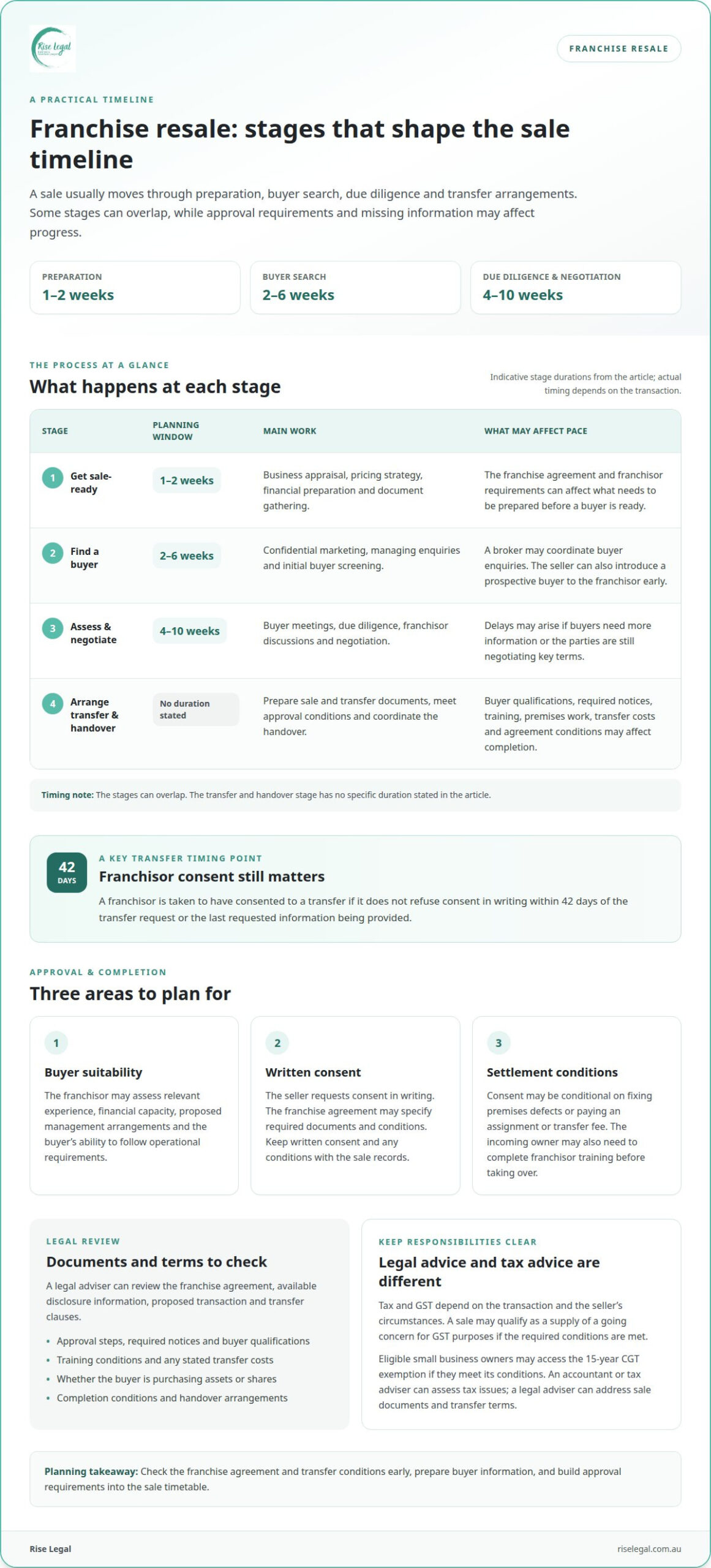
How Long Does It Take to Sell a Franchise?
There is no standard timeframe.
The timing can depend on:
- how quickly a suitable buyer is found;
- buyer due diligence;
- negotiation of the sale agreement;
- franchisor approval;
- lease arrangements;
- finance;
- training requirements; and
- other completion conditions.
The 42-day rule under the Franchising Code should not be confused with the overall timeframe for selling the business.
A transaction can take considerably longer depending on the circumstances.
Do You Need a Business Broker to Sell a Franchise?
No. There is no general requirement to appoint a business broker.
Some franchisees use brokers to market the business, deal with enquiries and assist in finding potential buyers.
Others choose to manage the commercial sale process themselves.
A broker's role is different from the legal work involved in the transaction.
Legal advice may still be needed to deal with the franchise transfer, sale agreement, lease and other transaction documents.
Resale Franchise vs Greenfield Franchise
From a buyer's perspective, purchasing an established franchise differs from opening a new franchise location.
An existing franchise may offer:
- a trading history;
- existing customers;
- staff;
- equipment;
- premises; and
- an established local presence.
A greenfield franchise, by contrast, involves establishing a new location or operation.
Neither option is automatically better.
The value and risk of an existing franchise depend on matters such as its trading performance, remaining franchise term, lease arrangements, liabilities and the strength of the franchise system.
Think About the Remaining Franchise Term
The remaining franchise term can materially affect the value of a resale.
The ACCC specifically notes that the value of a franchised business can reduce as the remaining term becomes shorter.
A prospective buyer will therefore want to understand:
- how long remains on the agreement;
- what renewal rights exist;
- what conditions apply to renewal; and
- what happens when the agreement expires.
For sellers, these issues can affect what a buyer is prepared to pay.
Why Legal Advice Early in the Sale Can Help
One of the biggest risks in a franchise resale is finding a buyer and negotiating a commercial deal before understanding the legal conditions that apply to the transfer.
Early legal advice can help identify issues involving:
- franchisor consent;
- transfer conditions;
- the franchise agreement;
- the lease;
- the sale structure;
- employees;
- transaction documents; and
- completion requirements.
The purpose is not simply to prepare paperwork at the end of the process. It is to identify legal issues that could affect the transaction before they become expensive or difficult to resolve.
Franchise Resale Lawyers Australia
Rise Legal assists franchisees across Australia with the legal aspects of selling franchised businesses.
We can advise on the franchise transfer requirements and assist with the business sale documentation involved in the transaction.
We also advise on franchise agreements and franchising matters.
Our services are offered on a fixed-fee basis, with the scope and professional fee agreed upfront.
If you are considering selling your franchise, contact Rise Legal before committing to the transaction.
Frequently Asked Questions
Can I sell my franchise without a business broker?
Yes. A business broker is not legally required. Some sellers use a broker to market the business and find buyers, while others manage that part of the process themselves.
Does my franchisor have to approve the buyer?
The franchisor will usually have rights under the franchise agreement relating to the proposed transfer. Under the Franchising Code, the franchisor must not unreasonably withhold consent.
Can my franchisor refuse to let me sell?
A franchisor may withhold consent in circumstances permitted by the franchise agreement and Franchising Code, but the refusal must not be unreasonable. The Code sets out examples of circumstances where withholding consent may be reasonable.
What happens if the franchisor does not respond?
Under the current Franchising Code, consent can be taken to have been given if the franchisor does not refuse consent in writing within 42 days of the later of the transfer request or, where further information is requested, the date the last of that information is provided.
Can the franchisor charge a transfer fee?
A transfer or assignment fee may apply if provided for under the franchise arrangements. Other transaction-related costs may also arise.
Does a buyer of an existing franchise have cooling-off rights?
Yes, cooling-off rights can apply under the Franchising Code. The applicable rules depend on whether the transaction involves a new franchise agreement or the transfer of an existing agreement.
Should I get legal advice before marketing my franchise?
Getting advice early can help you understand the transfer conditions, approval requirements and legal issues that may affect the transaction before you agree commercial terms with a buyer.

Article by Helen Kay, Principal Lawyer, Rise Legal
Helen Kay is the Managing Director and Principal Lawyer at Rise Legal, an Australian commercial and business law firm advising business owners, franchisors and franchisees across Australia. Helen practises in commercial law, franchising, business contracts, business sales and purchases, trademarks and related business law matters.
Disclaimer
This article provides general information only and does not constitute legal advice. It does not take into account your specific circumstances. Laws and regulatory requirements may change, so you should obtain legal advice relevant to your situation before acting on the information contained in this article. Liability limited by a scheme approved under professional standards legislation.