

The simpler-looking option isn’t always the better buy. A share purchase transfers ownership of the company with its history, while an asset purchase allows you to acquire specified business assets rather than the company itself. A business purchase lawyer in Australia can explain what each structure means for your proposed transaction before you commit.
It’s reasonable to focus first on the headline price, but the structure and contract terms determine what you’re actually taking on. The sale agreement should clearly set out what’s included, how liabilities are allocated and what protections apply.
This article explains how to compare a share purchase with an asset purchase, including the due diligence each may require. It also covers how legal advice can address customer and supplier contracts, the business lease, employee arrangements, required consents and the documents needed to complete the transaction.
Key Takeaways
- Compare a share purchase with an asset purchase by looking at the company’s history, the assets you want and the liabilities involved.
- Legal due diligence can examine key contracts, lease terms, employees, licences, intellectual property and security interests before the deal proceeds.
- Plan for lease consent and employee arrangements early and make sure the sale documents address how relevant transfers will happen.
- Have the proposed terms and contract reviewed before signing heads of agreement or paying a deposit so the deal’s inclusions, protections and conditions are clear.
Table of Contents
- What does a business purchase lawyer do?
- What happens to the lease and employees?
- Should I buy the shares or the business assets?
- Business purchase contract drafting and review
- Rise Legal: Business Sales & Purchases
- Frequently Asked Questions
What does a business purchase lawyer do?
A business purchase lawyer coordinates legal due diligence and helps prepare, review and negotiate the transaction documents. This work can include reviewing customer and supplier contracts, the lease, employment arrangements, licences, intellectual property and Personal Property Securities Register (PPSR) records.
Business Acquisition Due Diligence
During an acquisition, legal due diligence helps identify legal issues affecting the business and the transaction. Commercial lawyers can review customer and supplier contracts for termination and assignment rights, check employment arrangements and identify registered security interests through PPSR searches.
They can also assess whether key licences and approvals can transfer. For intellectual property, due diligence can examine who owns the relevant trade marks and whether the buyer will obtain the rights needed after settlement. Trade mark and intellectual property advice can assist with those issues.
Lawyer or Conveyancer Support
A conveyancer’s work generally centres on property transactions, while buying a business can involve contracts, goodwill, employees, intellectual property, leases and liabilities.
Choose a lawyer experienced in business acquisitions and sale agreements who can explain how the proposed structure affects the transaction documents. Legal advice addresses the legal transaction, while an accountant or tax adviser should separately advise on taxation, accounting treatment and the financial position of the business.
Steps in a Business Purchase
A business purchase lawyer may assist with:
- assessing the proposed transaction structure;
- reviewing heads of agreement or a letter of offer;
- conducting legal due diligence;
- reviewing or negotiating the business sale agreement;
- checking supplier and customer contracts;
- reviewing commercial lease arrangements;
- considering licences and approvals;
- reviewing employment arrangements;
- checking intellectual property ownership;
- conducting PPSR and other relevant searches;
- identifying third-party consents;
- documenting conditions, payment and liability allocation; and
- managing legal steps towards settlement.
Where possible, involve a lawyer before signing heads of agreement or paying a deposit. Once important commercial terms have been agreed, they may be more difficult to renegotiate.
Reducing Business Purchase Risks
Potential risks include undisclosed liabilities, contracts that can be terminated, unclear intellectual property ownership and security interests over assets.
A lawyer can identify these issues during due diligence and address them through contract terms, conditions, warranties, indemnities or other protections. The sale agreement can also specify which assets and liabilities are included.
These steps help clarify the transaction and each party’s responsibilities, although no due diligence process can remove every commercial risk.
What happens to the lease and employees?
Commercial Lease
If the business operates from leased premises, review the lease early in the transaction.
Important matters can include the remaining lease term, renewal options, permitted use, rent, outgoings, guarantees and conditions applying to an assignment. If landlord consent is required, the sale agreement can set out who will seek it, what information the landlord requires and what happens if consent is delayed or refused.
Employees
Employee arrangements need careful consideration when a business changes ownership. Depending on the circumstances, the Fair Work transfer of business rules may apply. Fair Work explains that a transfer of business may arise where an employee starts with the new employer within three months, performs substantially the same duties and there is a relevant connection between the old and new employers.
Employee roles, employment terms, service history, applicable awards or enterprise agreements and accrued entitlements should be considered as part of the transaction. The business sale agreement can address how agreed employee liabilities and adjustments will be handled between the buyer and seller.
Licences, Approvals and Intellectual Property
Prepare a schedule for important licences, approvals and intellectual property used by the business.
For each item, consider:
- who currently owns or holds it;
- what business activity it supports;
- whether it can be transferred;
- whether third-party consent is required; and
- whether the buyer will need to obtain a replacement licence or approval.
For trade marks, identify the registered owner and the rights intended to transfer. A business name registration is not, by itself, proof of ownership of a trade mark.
Customer and Supplier Contracts
Key supplier and customer arrangements should also be mapped against the transition plan.
Some contracts may contain assignment or change-of-control provisions requiring consent before the relationship can continue with the buyer or following a change in company ownership.
Identify important contracts early so any required consent process can be built into the transaction timetable.
Should I buy the shares or the business assets?
The choice depends on which assets and liabilities you want to acquire and how the business operates. Australian business sale and purchase transactions can involve legislation including the Corporations Act 2001 (Cth).
Asset Purchase Structure
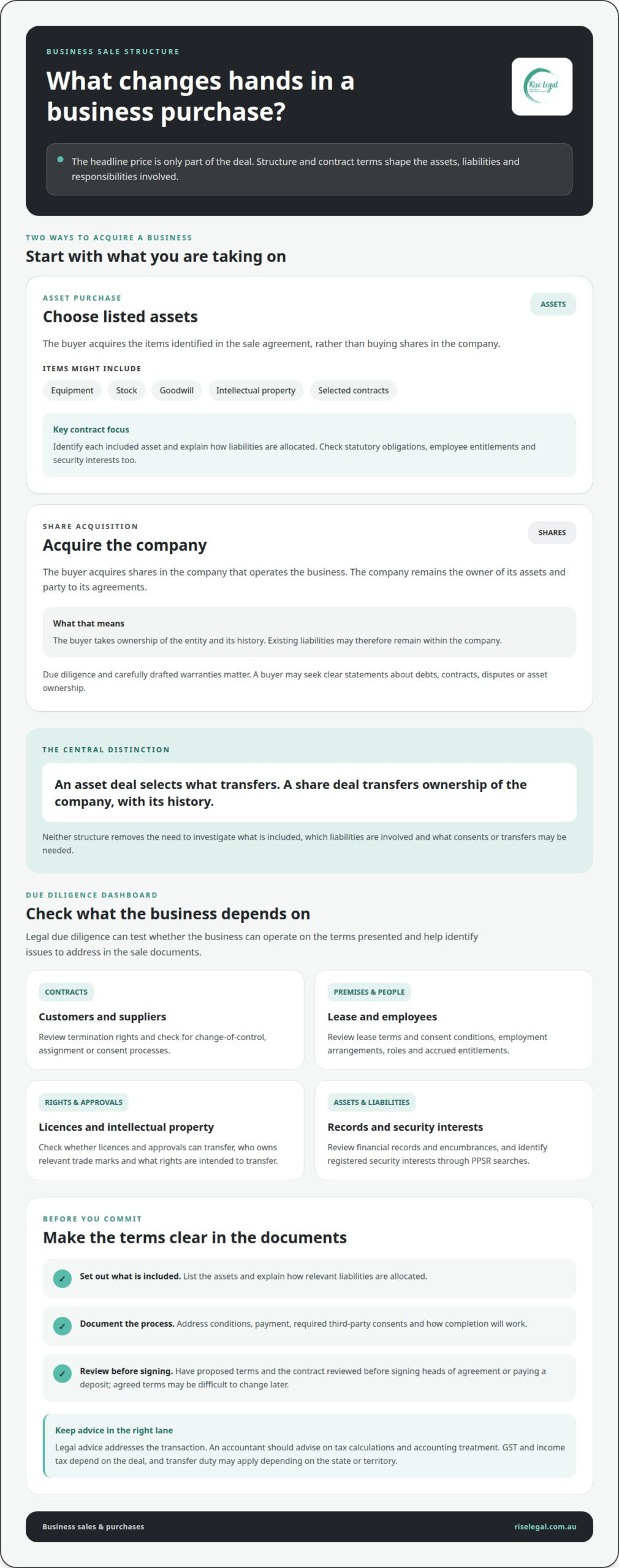
In an asset purchase, the buyer acquires specified assets of the business rather than buying shares in the company that currently operates it.
Those assets may include:
- equipment;
- stock;
- goodwill;
- intellectual property;
- business names;
- domain names and websites;
- customer and supplier contracts;
- licences and permits; and
- rights under a commercial lease.
The sale agreement should identify each included asset and explain how liabilities, transfers and consents will be dealt with.
An asset purchase can allow the buyer to select what it is acquiring, but employee obligations, contractual restrictions, statutory obligations and security interests still need to be investigated.
Share Acquisition Structure
With a share acquisition, the buyer acquires shares in the company that operates the business.
The company remains the owner of its assets and a party to its existing contracts, while the buyer takes ownership of the company and its history. Existing liabilities can therefore remain within the company.
Due diligence and carefully drafted warranties can be particularly important. For example, the buyer may seek protections dealing with debts, contracts, disputes, taxation and ownership of assets.
Business Asset Protection and Transfer
For an asset sale, the agreement should describe how each asset will be transferred, including any required consent, assignment or registration.
A customer or supplier contract, for example, may not transfer if its terms restrict assignment.
Buyers should also identify security interests over equipment and other business assets. The Australian Government’s PPSR guidance recommends searching the register when buying personal property because registered security interests can affect the buyer’s position. You can read more in our guide to the Personal Property Securities Register.
The agreement should also clearly deal with goodwill, the business’s trading name and intellectual property rights.
Business purchase contract drafting and review
The sale agreement turns commercial terms into legal obligations, so it is worth having it reviewed before signing heads of agreement or paying a deposit. Key commercial terms can become difficult to change once accepted.
What Should the Contract Cover?
The agreement should clearly identify matters including:
- the assets or shares being purchased;
- the purchase price and deposit;
- payment timing;
- stock and settlement adjustments;
- liabilities assumed by each party;
- commercial lease arrangements;
- employee arrangements;
- intellectual property;
- customer and supplier contracts;
- conditions that must be satisfied before settlement;
- warranties and indemnities;
- restraint provisions;
- handover or training requirements;
- PPSR releases; and
- post-settlement obligations.
If part of the purchase price depends on future performance, an earn-out may require detailed provisions explaining how performance will be measured and calculated. Vendor finance may also require specific repayment and security terms.
Conditions Precedent
The agreement may make finance approval, satisfactory due diligence, landlord consent, franchisor consent or other third-party approvals conditions of the sale.
The contract should identify who is responsible for satisfying each condition, the relevant deadline and what happens if a condition is not satisfied.
GST and Going Concern Issues
The tax treatment of a business sale should be considered with your accountant or tax adviser. The Australian Taxation Office states that a sale of a business as a going concern can be GST-free if the relevant requirements are met, including that the parties agree in writing that the sale is of a going concern, the buyer is registered or required to be registered for GST and the seller supplies everything necessary for the continued operation of the business.
Legal advice can address how the transaction documents deal with GST, while the tax consequences should be confirmed with your accountant or tax adviser.
Restraint Clauses
A buyer may seek restraint provisions preventing the seller from carrying on certain competing activities following settlement.
The enforceability of a restraint depends on the applicable law and the circumstances, including its wording, duration, geographic scope and the activities being restricted. The restraint should relate appropriately to the business and goodwill being acquired.
A focused legal review can reveal gaps, unclear liability allocation or conditions that do not match the intended transaction.
For more information, visit our Business Sales & Purchases page.
Rise Legal: Business Sales & Purchases
Rise Legal advises buyers and sellers on business sale and purchase transactions throughout Australia, including transaction structure, legal due diligence and business sale agreements.
Depending on the transaction, we can assist with:
- reviewing or preparing a business sale agreement;
- legal due diligence;
- asset and share purchases;
- commercial lease matters;
- employee transfer arrangements;
- intellectual property transfers;
- PPSR searches and security interests;
- conditions precedent;
- restraint provisions;
- franchise-related requirements; and
- settlement and handover arrangements.
We provide fixed-fee proposals with upfront pricing for defined legal work, so you know the scope and proposed professional fee before work begins.
Tax, accounting and financial advice are separate from legal advice and may also be required.
Take the next step with a clear plan
Get advice before committing to a purchase, while you can still consider the structure and contract terms. A business purchase lawyer in Australia can help assess the legal work involved in your proposed transaction and identify the documents and decisions that need attention.
Rise Legal also provides advice in areas including franchising, trade marks and Terms & Conditions. These services may be relevant when a business purchase involves a franchise relationship, intellectual property rights or customer-facing contracts.
For an initial discussion, outline where the purchase stands, whether you are considering shares or assets and any key deadlines or concerns.
Contact Rise Legal about your business purchase to discuss the legal work involved and request a fixed-fee proposal.
Frequently Asked Questions
Are there specific rules for transferring employees?
Yes. Employee arrangements need to be assessed against the circumstances of the transaction and applicable workplace laws.
Under Fair Work rules, a transfer of business can arise where an employee starts working for the new employer within three months of ending employment with the old employer, performs the same or substantially the same work and there is a relevant connection between the employers.
Employee service may need to be recognised for certain entitlements, although the treatment of annual leave, redundancy, long service leave and some other entitlements can depend on the circumstances.
How long does a typical business sale process take?
There is no single reliable timeframe for every Australian business sale. Timing depends on the complexity of the transaction and matters including due diligence, negotiations, finance, landlord consent, franchise approval, licences and other conditions.
A transaction with organised records and responsive parties can progress differently from one where key information or approvals are delayed.
What documents are involved in a business sale?
The documents required depend on the transaction but may include heads of agreement, the business sale agreement, asset schedules, lease assignment or new lease documents, intellectual property assignments, employee information, corporate approvals, PPSR releases and settlement documents.
The sale agreement should identify the documents each party must provide before or at settlement.
What does a business purchase lawyer in Australia do?
A business purchase lawyer advises on the legal aspects of buying a business. This can include transaction structure, legal due diligence, reviewing or drafting the sale agreement, checking leases and contracts, examining intellectual property and security interests and managing the legal steps towards settlement.
Legal advice is separate from an accountant’s assessment of the business’s financial records, valuation and tax consequences.
What should an Australian business sale contract include?
A business sale contract should clearly identify what is being sold, the purchase price and payment arrangements, conditions of the sale, liabilities and adjustments, warranties, employee and lease arrangements, intellectual property, completion requirements and any continuing obligations following settlement.
The terms should reflect the actual commercial transaction rather than relying on assumptions about what will transfer automatically.
How do business purchase lawyers handle leases, licences, employees and contracts in Australia?
Each arrangement should be assessed to identify what action is required, who is responsible and when it needs to occur.
For example, a commercial lease may require landlord consent, a licence may require a new application, a customer contract may require consent to assignment and employee arrangements may need to be considered under workplace laws.
Mapping these requirements early helps coordinate the legal and operational steps required for settlement.
About the Author
Helen Kay, Principal Lawyer, Rise Legal
Helen Kay is the Managing Director and Principal Lawyer at Rise Legal, an Australian commercial and business law firm advising business owners, franchisors and franchisees across Australia. Helen practises in commercial law, franchising, business contracts, business sales and purchases, trade marks and related business law matters.
Disclaimer
This article provides general information only and does not constitute legal advice. It does not take into account your specific circumstances. Laws and regulatory requirements may change, so you should obtain legal advice relevant to your situation before acting on the information contained in this article. Liability limited by a scheme approved under professional standards legislation.