

How to Negotiate the Sale of a Business
Negotiating the sale of a business involves much more than agreeing on a headline price.
Payment terms, due diligence, stock, leases, employees, intellectual property, handover arrangements and conditions of sale can all affect what the seller ultimately receives and whether the transaction proceeds smoothly.
Preparing before offers arrive can put you in a stronger position. That means understanding what the business is worth, deciding which terms matter most to you and having the information a serious buyer is likely to request.
Key Takeaways
- Consider the entire offer, not just the purchase price.
- Know your preferred outcome, minimum acceptable terms and areas where you have room to negotiate.
- Prepare financial, contractual and operational information before detailed buyer due diligence begins.
- Identify leases, licences, permits, contracts and intellectual property that may require transfer or third-party consent.
- Record agreed commercial terms carefully and make sure they are reflected correctly in the Business Sale Agreement.
How Do You Negotiate the Sale of a Business?
Negotiations can start with the first enquiry or offer and continue through due diligence, contract negotiations and sometimes right up until completion.
A structured approach helps sellers compare proposals and focus on the commercial terms that matter.
1. Prepare the Business for Sale
Before approaching potential buyers, identify what is actually being sold and prepare information that explains the business clearly.
Depending on the business, this might include information about:
- financial performance;
- business assets;
- stock;
- customer and supplier arrangements;
- employees;
- premises;
- intellectual property and trademarks;
- licences and permits; and
- other important contractual arrangements.
Sensitive information should be disclosed through an appropriate process rather than being included in public advertising material.
2. Understand What the Buyer Is Offering
A high headline price does not necessarily mean an offer is commercially better.
Consider the whole proposal, including:
- how and when the purchase price will be paid;
- any deposit;
- finance conditions;
- due diligence conditions;
- the proposed completion date;
- whether any part of the price is deferred;
- any earn-out or performance-based component;
- the proposed handover period; and
- other conditions the buyer wants satisfied.
A lower offer with straightforward payment and limited conditions may sometimes be more attractive than a higher offer involving significant uncertainty or deferred consideration.
3. Assess the Buyer
Before providing extensive confidential information or agreeing to exclusivity, consider whether the prospective buyer appears able and willing to proceed.
Understanding the buyer’s proposed structure, finance position and intended timing can also help identify issues that may affect the transaction.
4. Consider Competing Offers Carefully
If there is genuine interest from more than one potential buyer, comparing competing offers may strengthen the seller’s negotiating position.
However, sellers should not suggest that competing offers exist when they do not.
Once an exclusivity arrangement is agreed, the seller may also be restricted from negotiating with other parties for the agreed period.
5. Prepare for Due Diligence
A buyer will commonly conduct due diligence before becoming unconditionally committed to the acquisition.
The information requested depends on the transaction but may include financial statements, tax information, commercial contracts, leases, employee information, licences, intellectual property records and other documents relating to the operation of the business.
Preparing these materials early can help identify issues before the buyer does and make the due diligence process easier to manage.
Know Your Negotiating Priorities
Before offers arrive, decide which terms are most important to you.
These might include:
- the minimum price you are prepared to accept;
- how much must be paid at completion;
- your preferred settlement timing;
- how long you are prepared to assist with handover;
- whether you will accept deferred consideration;
- what restraint obligations you are prepared to accept; and
- which conditions you consider essential.
Separating essential requirements from negotiable points can make it easier to respond to counteroffers.
For example, a seller may be willing to provide additional handover assistance in exchange for stronger payment terms or greater certainty around completion.
How Is a Business Valued?
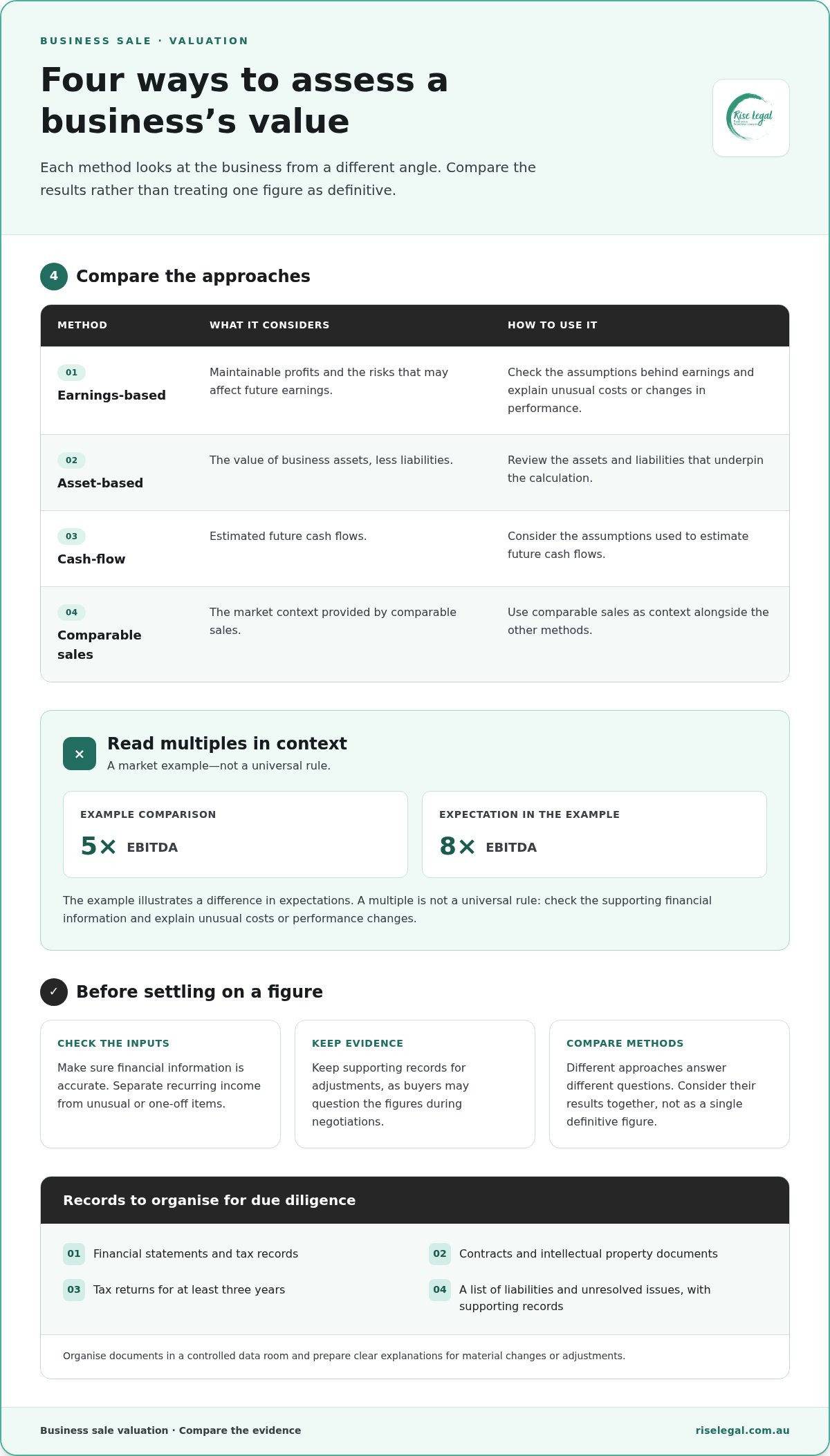
There is no single valuation method that applies to every business.
Common approaches may consider:
- maintainable earnings or profits;
- business assets and liabilities;
- cash flow;
- comparable business sales;
- goodwill;
- industry conditions; and
- the risks and opportunities associated with the business.
A professional business valuer or accountant can help assess an appropriate valuation methodology for the particular business.
If an earnings multiple is used, it should not simply be treated as an industry rule. The appropriate multiple can depend on matters such as business size, recurring revenue, customer concentration, dependence on the owner and other commercial risks.
Can You Sell a Business Privately?
Yes. A business owner can sell privately without using a business broker.
A private sale gives the seller more direct control over enquiries and negotiations, but also means taking responsibility for marketing the business, identifying potential buyers, managing information requests and progressing negotiations.
Even where a business is being sold privately, a lawyer and accountant can assist with their respective legal, financial and tax aspects of the transaction.
Price Is Only One Part of the Deal
Business-sale negotiations should consider the economic effect of the entire transaction rather than focusing solely on the number at the top of the offer.
Payment Terms
Consider how much of the purchase price will be paid at completion and whether any amount will be deferred.
If payment depends on future business performance, the agreement should clearly address how that performance will be measured, who controls the business during the relevant period and what happens if the parties disagree.
Deposit
The parties may agree that the buyer will pay a deposit towards the purchase price.
A deposit of around 10% is commonly referred to in Australian business-sale guidance, but the actual amount is negotiable and should be recorded in the sale agreement along with the circumstances in which it may be retained or refunded.
Stock
Stock can be included in the purchase price or dealt with separately.
If stock is to be valued at completion, the parties should agree on the method for counting and valuing it and how obsolete, damaged or slow-moving stock will be treated.
Adjustments
The purchase price may also require adjustments at completion for amounts relating to the operation of the business before and after the transfer.
The appropriate adjustments depend on the particular transaction and should be addressed in the Business Sale Agreement.
Tax Considerations
The tax consequences of selling a business depend on the structure of the transaction and the assets involved.
Capital gains tax and GST may need to be considered, and small business CGT concessions may potentially apply in some circumstances.
A business sale may also qualify as a GST-free supply of a going concern where the relevant legal requirements are satisfied.
Tax advice should be obtained from an accountant or tax adviser before the seller agrees on expected net proceeds or the tax treatment of the transaction.
Leases and Business Premises
If the business operates from leased premises, the lease can be a major part of the transaction.
Review matters such as:
- the remaining lease term;
- renewal options;
- rent and rent reviews;
- assignment provisions;
- landlord consent requirements; and
- any guarantees or security arrangements.
The transaction may depend on the landlord approving an assignment of the existing lease or entering into a new lease with the buyer.
The sale documentation should address who is responsible for obtaining the required consent and what happens if it cannot be obtained.
Licences and Permits
Some businesses depend on government or industry licences, approvals or permits.
These should be identified early because they may not automatically transfer with the business.
Depending on the particular approval, the buyer may need to apply for a transfer or obtain a new licence in its own name.
Government guidance warns that some licence and permit transfers can take considerable time, so these issues should be investigated well before the proposed completion date.
Asset Sale or Share Sale?
The structure of the transaction also matters.
In an asset sale, the buyer acquires specified assets of the business. These may include equipment, stock, goodwill, contracts, intellectual property and other agreed assets.
In a share sale, the buyer acquires shares in the company that operates the business. The company continues to own its assets and remain responsible for its obligations, subject to the terms of the transaction.
These structures have different legal, financial and tax implications, so the intended structure should be clear before detailed sale documents are prepared.
Intellectual Property and Trademarks
Business owners should confirm who owns the intellectual property associated with the business before promising that it will transfer to the purchaser.
Depending on the business, this may include:
- registered trademarks;
- business names;
- domain names;
- websites;
- copyright material;
- software;
- confidential information; and
- other proprietary material.
Registering a business name does not itself provide the same rights as owning a registered trademark.
If intellectual property forms an important part of the transaction, our trademark and intellectual property lawyers can assist with identifying and documenting the relevant rights.
Employees and Handover
Employees may also need to be addressed as part of the transaction.
The sale agreement should deal with matters relevant to the particular sale, including any arrangements concerning transferring employees and responsibility for employee entitlements.
A seller may also agree to provide training or other handover assistance after completion.
If so, the agreement should identify the expected scope and duration of that assistance rather than leaving the parties with different expectations after settlement.
Warranties, Indemnities and Liability
Price negotiations often receive the most attention, but the warranties and indemnities in the Business Sale Agreement can materially affect the seller’s ongoing exposure after completion.
The parties may negotiate matters including:
- the warranties the seller must provide;
- any specific indemnities;
- limitations on liability;
- minimum claim thresholds;
- time limits for contractual claims; and
- procedures for notifying claims.
These provisions should be considered as part of the overall commercial deal rather than left until the end of negotiations.
Recording the Negotiated Deal
As negotiations progress, keep a clear record of offers, counteroffers and agreed changes.
A Heads of Agreement may be used to record the principal commercial terms before the detailed sale agreement is prepared.
Care is required because a Heads of Agreement may be binding, non-binding or partly binding depending on its wording and the parties’ intentions.
The final Business Sale Agreement should then accurately reflect the commercial arrangement the parties have negotiated.
Legal Support When Selling a Business
Rise Legal assists Australian business owners with the legal aspects of business sales and purchases.
Depending on the transaction, we can assist with preliminary sale documents, Business Sale Agreements, negotiations, due diligence, lease matters and other commercial issues connected with the sale.
For defined legal work, Rise Legal offers fixed-fee proposals and upfront pricing so you know the scope and professional fee before work begins.
Contact Rise Legal if you are preparing to sell a business and would like assistance with the transaction.
Frequently Asked Questions
When does negotiation of a business sale begin?
Negotiation can begin from the first offer or discussion and continue throughout due diligence and preparation of the Business Sale Agreement. Commercial terms may continue to change until the parties enter into a binding agreement.
How much room is there to negotiate when selling a business?
There is no standard percentage. The seller’s negotiating position depends on the business, buyer interest, valuation, proposed conditions and other commercial circumstances. Different parts of the offer may also have different levels of flexibility.
What determines the sale price of a business?
The agreed price results from negotiations between the buyer and seller and may be informed by financial performance, assets, goodwill, market conditions, comparable sales and professional valuation advice.
Is a 10% deposit compulsory when selling a business?
No. A deposit of around 10% is commonly used as a reference point in Australian business sales, but there is no universal requirement that every business sale use a 10% deposit. The amount and terms should be agreed between the parties and recorded in the sale documentation.
Can I sell my business without a broker?
Yes. A business can be sold privately. The seller will generally need to manage advertising, buyer enquiries and negotiations directly, while lawyers and accountants can still assist with the legal, financial and tax aspects of the sale.
What should I check before accepting an offer?
Consider the purchase price together with payment terms, conditions, proposed completion timing, due diligence, finance, handover obligations, leases, employee arrangements and any deferred or performance-based component of the price.

Article by Helen Kay, Principal Lawyer, Rise Legal
Helen Kay is the Managing Director and Principal Lawyer at Rise Legal, an Australian commercial and business law firm advising business owners, franchisors and franchisees across Australia. Helen practises in commercial law, franchising, business contracts, business sales and purchases, trademarks and related business law matters.
Disclaimer
This article provides general information only and does not constitute legal advice. It does not take into account your specific circumstances. Laws and regulatory requirements may change, so you should obtain legal advice relevant to your situation before acting on the information contained in this article. Liability limited by a scheme approved under professional standards legislation.