

When you’ve invested time and money into creating a unique name or logo for your business, the next step is thinking about how to protect it. You might have seen the small ™ and ® symbols next to brand names and wondered what they mean, which one you should use, and what level of protection they offer.
Understanding the difference matters for Australian business owners. Using these symbols correctly signals your intentions to the market, while misusing them can have legal consequences. This guide explains the distinction between the TM (™) and R (®) symbols in Australia, helping you make informed decisions about your brand.
Table of Contents
- What Does the TM Symbol (™) Mean?
- TM vs ®: Understanding the Key Differences
- Business Name Registration: A Common Point of Confusion
- Practical Steps for Your Trade Mark
What Does the TM Symbol (™) Mean?
The ™ symbol is used to indicate that you are claiming a name, logo, or slogan as a trade mark. Think of it as a notice to the public that you are using that particular branding to identify your goods or services in the marketplace.
- It’s for unregistered trade marks: You do not need to have a trade mark application filed or approved with IP Australia to use the ™ symbol.
- It’s a claim, not a guarantee: Using the ™ symbol shows you are using the mark as a trade mark, but it does not in itself grant you enforceable legal rights or confirm that the mark is registrable.
- It can act as a deterrent: Displaying the ™ symbol can discourage competitors from using a similar name or logo, as it signals you consider the brand to be your intellectual property.
Who Can Use the TM Mark?
Any individual or business in Australia can use the ™ symbol next to a brand name or logo they are using for commercial purposes. There are no formal requirements or registration processes to use it. However, it’s important to understand that simply adding a ™ does not mean you have exclusive rights to that name or logo.
While using the ™ symbol does not create statutory trade mark rights, a history of using a mark in the course of trade can sometimes help establish common law rights. These rights are based on the reputation your brand has built over time within a specific geographical area. Using the ™ symbol can be part of the evidence that shows you have been using the brand as a trade mark, which may be relevant in a dispute or during the trade mark application process in some circumstances.
TM vs ®: Understanding the Key Differences
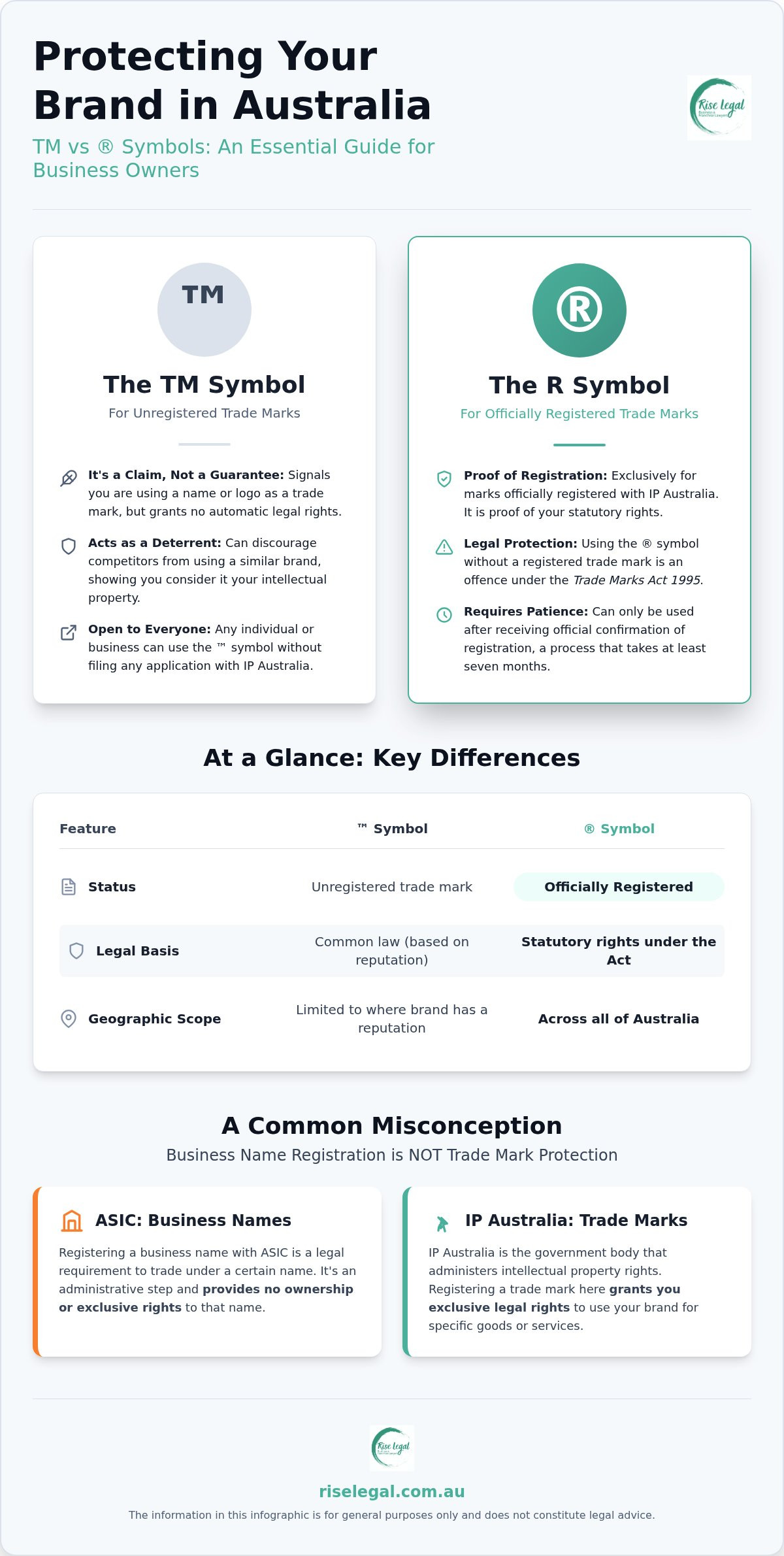
The main difference between the ™ and ® symbols comes down to registration. The main difference is that the ™ symbol can be used with an unregistered mark, while the ® symbol indicates that the trade mark is registered in Australia.
The ® symbol indicates that a trade mark has been officially registered with the national trade mark office, which in Australia is IP Australia. It is reserved exclusively for marks that have completed the examination process and are listed on the Australian Register of Trade Marks.
Using the ® symbol incorrectly is a serious matter. Under section 151 of the Trade Marks Act 1995, it is an offence to falsely represent a trade mark as being registered. This offence carries a maximum penalty of 60 penalty units.
Here’s a simple comparison:
| Feature | TM Symbol (™) | Registered Symbol (®) |
|---|---|---|
| Status | Unregistered trade mark | Officially registered with IP Australia |
| Requirement | No application needed. Can be used by anyone claiming a mark. | Requires a successful trade mark application and registration. |
| Indication | Signals a claim to a trade mark. | Signals official registration of a trade mark. |
| Legal Basis | Using ™ does not create statutory trade mark rights. Rights relating to an unregistered mark may arise under other areas of law depending on the circumstances. | Provides statutory rights under the Trade Marks Act 1995. |
| Geographic Scope | Common law rights are generally limited to the geographic area where the brand has a reputation. | Registration provides statutory rights across all of Australia for the specified goods or services. |
The Benefits of a Registered Trade Mark (®)
Applying to register your trade mark is a significant step in formalising your brand protection. Once registered, you can use the ® symbol, which provides several advantages:
- Exclusive Rights: A registered trade mark gives you the exclusive right to use, license, and sell the mark for the goods and services it’s registered for throughout Australia.
- A Business Asset: A registered trade mark is an intellectual property asset. It can add value to your business, which can be particularly important if you plan to sell, seek investment, or franchise your business in the future.
- Clearer Enforcement: It is generally more straightforward to enforce your rights with a registered trade mark than it is to rely on common law rights.
When Exactly Can You Switch to the ®?
You can only start using the ® symbol once your trade mark is officially registered with IP Australia. You cannot use it while your application is still pending or under examination. The trade mark registration process in Australia takes at least seven months from the date of filing, so it’s important to wait until you receive confirmation that your mark has been registered.
Business Name Registration: A Common Point of Confusion
Many Australian business owners believe that registering a business name with the Australian Securities and Investments Commission (ASIC) gives them ownership or exclusive rights to that name. This is a common and potentially costly misunderstanding.
Registering a business name is a legal obligation that allows you to trade under a name different from your own or your company’s name. It does not provide any proprietary rights over the name itself.
- ASIC administers the registration of business, company, and body names. Its role is primarily administrative.
- IP Australia administers the registration of intellectual property rights, including trade marks.
This means that even if you have registered a business name, another person could potentially register that same name (or a similar one) as a trade mark for related goods or services. If another person obtains trade mark rights in the same or a similar name, that may affect your ability to continue using the name, depending on the circumstances. That’s why including a trade mark strategy as part of your overall business structuring is a sound approach.
Practical Steps for Your Trade Mark
If you’re looking to protect your brand name or logo, here is a general process to consider:
- Conduct a search. Before you invest heavily in a brand, it’s a good idea to search the Australian Trade Mark Search to see if your desired name or logo is already in use or registered by someone else.
- Decide whether to use the ™ symbol. While your mark is unregistered, you may choose to use the ™ symbol on your website, packaging, and marketing materials to indicate that you are using it as a trade mark.
- Consider applying for registration. To gain the protection offered by the ® symbol, you will need to lodge an application with IP Australia. This involves identifying the appropriate classes of goods and/or services your brand relates to.
- Use the ® symbol after registration. Once your application is approved and your mark is officially registered, you can begin using the ® symbol to signify your registered status.
Where Should the Symbol Sit on Your Logo?
While there are no strict laws on placement, a common convention is to place the symbol, whether ™ or ®, at the top right (superscript) of the logo or brand name. The key is for it to be clear but not intrusive, maintaining a professional look for your branding.
How We Can Help
The trade mark registration process involves a number of decisions, including selecting the mark and identifying the relevant goods and services. At Rise Legal, we assist start-ups and established businesses with their intellectual property needs. We can help you with the trade mark registration process, offering straightforward guidance and fixed-fee proposals so you know the costs upfront.
Ready to formalise the protection of your brand? Contact Rise Legal for a fixed-fee trade mark proposal today.
Frequently Asked Questions (FAQs)
Can I use the TM symbol if I haven’t applied for registration yet?
Yes. The ™ symbol can be used with any trade mark that has not been registered with IP Australia. Its purpose is to show that you are using a particular name or logo as a brand identifier for your goods or services, regardless of whether you have filed an application.
Is it a legal requirement to use the ™ or ® symbols in Australia?
No, there is no legal requirement to use either symbol. You can have a registered trade mark and choose not to display the ® symbol. However, using the ® symbol is a clear way to inform the public and competitors that your trade mark is registered.
What happens if I use the ® symbol on my logo before it is registered?
Using the ® symbol before your trade mark is officially registered is an offence in Australia under the Trade Marks Act 1995. It is considered a false representation of registration and can result in a significant penalty. You must wait until your mark is on the register before you can use the ® symbol.
Does a trade mark protect my logo internationally or just in Australia?
An Australian trade mark registration provides protection within Australia. Australia is a member of the Madrid System, which provides a process for seeking trade mark protection in multiple participating countries through an international application. Each designated country still examines the application under its own laws.
What is the difference between a trade mark and a copyright symbol (©)?
Trade marks and copyright protect different types of intellectual property.
- A trade mark (™ or ®) protects branding elements that identify the source of goods or services, such as a business name, logo, or slogan.
- Copyright (©) protects the expression of original ideas in literary, artistic, dramatic, or musical works. This includes things like website content, photographs, software code, and books.
A logo can be protected by both. It can be protected by copyright as an original artistic work and by trade mark law as a symbol used to distinguish your business in the marketplace.

Article by
Helen Kay, Principal Lawyer, Rise Legal
Helen Kay is the Managing Director and Principal Lawyer at Rise Legal, an Australian commercial and business law firm advising business owners, franchisors and franchisees across Australia. Helen practises in commercial law, franchising, business contracts, business sales and purchases, trade marks and related business law matters.
Disclaimer
This article provides general information only and does not constitute legal advice. It does not take into account your specific circumstances. Laws and regulatory requirements may change, so you should obtain legal advice relevant to your situation before acting on the information contained in this article. Liability limited by a scheme approved under professional standards legislation.
Share this article using the links below:


